


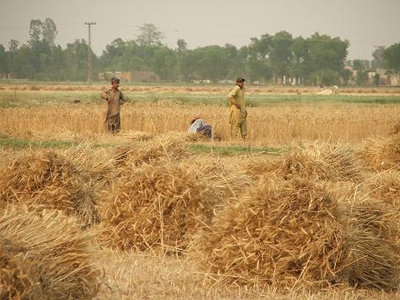
 ISLAMABAD: Food and Agriculture Organization (FAO) expected good wheat harvest to yield enough food for half a million poor rural households.
"With an average family size of eight, this translates into a harvest large enough to feed four million people for the next six months", said Daniele Donati, Chief, FAO Emergency Operations Service.
FAO spent $54 million of international donor funding buying and distributing quality wheat seeds as part of its emergency intervention that began last August, he informed, said a news release received here.
Once the harvest is completed, this donation will have produced a crop worth almost $190 million in wheat flour, the main staple, at current local retail prices, he noted adding, "The investment made by donors has been quadrupled".
As part of its immediate response to the floods, FAO led the UN's Agriculture Cluster, comprised of over 200 organizations, reaching 1.4 million farming families across the country.
FAO received $ 92 million of its $ 107 million appeal, which has enabled it to shore up the smallholder agricultural system in the four Pakistan provinces affected by the flooding.
The donors were Australia, Belgium, Canada, the UN Central Emergency Response Fund (CERF), the European Commission, IFAD, Italy, Sweden, the United Kingdom and the United States of America.
As well as supporting the "Rabi" wheat planting season, it is estimated that FAO saved the lives of almost a million livestock by supplying temporary shelter and enough de-worming tablets and dry animal feed for almost 290,000 families.
Green fodder is now becoming available as the harsh Pakistan winter turns to spring.
"The livestock interventions really paid off," Donati said adding, it costs ten times more to buy a new animal, which often represent a family's lifetime savings.
The UN agency will shortly distribute quality rice seeds to almost 25,000 families in Sindh for the upcoming planning season, but over 700,000 families will require assistance over the coming months.
FAO, in partnership with the government of Pakistan has identified recovery priorities for the next two years. These are increasing crop, livestock, fishery and agro-forestry production, improving diets and nutrition and boosting agriculture extension services to offer advice to landless and smallholder farmers.
"Pursuit of these core objectives will significantly reduce the vulnerability of the populations in question, improve food production and income generation, and increase affected communities' resilience to future shocks," said Donati.
FAO expects its recovery programme to cost $94 million, enough to assist 430,000 families in 24 districts. An Early Recovery Working Group, co-chaired by the Pakistan Government's National Disaster Management Authority and the United Nations Development Programme, has been set up with eight sectors covered including one on Agriculture and Food Security, co-chaired by FAO, the World Food Programme, and the Ministry of Food and Agriculture.
?




















Comments
Comments are closed for this article.