


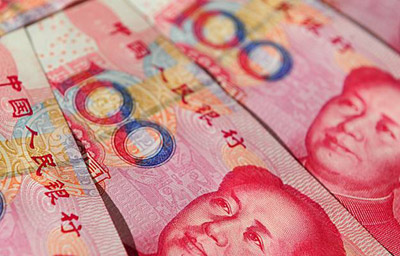
 SHANGHAI: The yuan was almost unchanged against the dollar on Thursday as poor reading of China's manufacturing activity in August offset a weakening of the US currency in global markets, traders said.
The HSBC Flash China manufacturing purchasing managers index (PMI) fell to 47.8 in August, its lowest level since November, as new export orders slumped and inventories rose, a signal that a persistent slowdown in the world's second-largest economy has extended deeper into the third quarter.
The poor data offset strengthened interest in the yuan in early trade, sparked by a fall in the dollar index to its nearly two-month low after minutes of the US Federal Reserve suggested it is willing to deliver more stimulus unless the economy improves considerably.
In the latest sign that Chinese companies increasingly tend to keep dollars in hand due to expectations of yuan depreciation amid a sharply slowing economy, two major Chinese banks cut interest rates on foreign currencies to push clients to use more dollars, traders said.
"The economy, in particular exports, continues to perform worse than expected, weakening sentiment towards the yuan," said a trader at an Australian bank in Shanghai.
"That means that pressure on the yuan to depreciate won't disperse any time soon," he said. "The yuan should encounter resistance at 6.35 versus dollar."
Traders expect the spot yuan's nearest support will be 6.37.
Spot yuan was trading at 6.3517 per dollar at midday, compared with Wednesday's close of close 6.3518 after moving in a narrow range of only 39 pips.
Before trading began, the PBOC fixed its daily midpoint at 6.3316, slightly stronger than Wednesday's 6.3348 to reflect the dollar's fall in global markets, but the rise in the fixing was less than the dollar's drop.
DOLLAR FUNDING COSTS PLUNGE
Strong dollar demand for much of 2012 has caused the yuan to fall this year, sinking by as much as 1.6 percent against the dollar in late July when the dollar index hit a two-year high.
But the yuan has regained some ground since then as dollar hoarding by Chinese companies abated, leaving the yuan down 0.9 percent for the year to date. Traders said dollar hoarding still persists.
Top Chinese lender Industrial and Commercial Bank of China and another state-owned giant Agricultural Bank of China on Wednesday reduced their interest rates for the dollar and other foreign currencies as an abundance of dollars in corporate hands has driven dollar funding costs to a record low.
US dollar funding costs implied in China's one-year currency swaps hit a record low of 0.568 percent on Monday before it rebounded slightly to 0.665 percent on Wednesday. Thursday's figure will be available late afternoon.
"Companies have too many dollars on hand," said a trader at a Chinese commercial bank in Shenzhen. "And that has also encouraged our clients to swap dollar contracts for yuan liquidity on the currency market ."
Benchmark onshore one-year dollar/yuan forwards
were bid at 6.4808 at midday, little changed from Wednesday's close of 6.4808, with their implied yuan depreciation remaining stable at around 2 percent.
The forwards have jumped 1,654 pips so far this year on expectations of a yuan depreciation as China's economic growth slowed to a three-year low.
More recently, onshore forwards -- used by corporations to swap dollar contracts for cash yuan -- have also been affected by a Chinese local-currency money market squeeze, partly caused by the central bank's resistance to calls to do more to support the economy.
The PBOC fears such steps could reinflate property prices and aggravate industrial overcapacity, traders said.
On Thursday, it conducted its largest weekly injection of funds into China's banking system in seven months, aiming to give banks the short-term liquidity they badly needed.
In a move that traders and analysts see as a substitute for a cut in RRR, the PBOC injected a net 278 billion yuan ($43.77 billion) into the money market this week, the largest net injection since early January.
















Comments
Comments are closed for this article.