


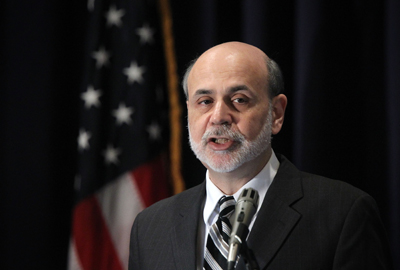
 WASHINGTON: The US economy needs to grow more quickly if it is to produce enough jobs to bring down the unemployment rate, Federal Reserve Chairman Ben Bernanke said on Monday, tamping down expectations of a quick reversal of monetary easing.
Bernanke said the recent decline in the jobless rate, which dropped to 8.3 percent in February from 9.1 percent last summer, was "somewhat out of sync" with the rather modest pace of economic growth.
US gross domestic product grew 3 percent in the fourth quarter, but is expected to have slowed to just below 2 percent in the first three months of this year. For all of last year, it grew only 1.7 percent, which would normally be too slow to move the unemployment rate lower.
Bernanke said the recent drop in the jobless rate could reflect an effort by businesses to recalibrate their payrolls after unusually heavy job cuts during the recession. If this is the case, he said, progress may stall.
"To the extent that this reversal has been complete, further significant improvements in the unemployment rate will likely require a more rapid expansion of production and demand from consumers and businesses, a process that can be supported by continued accommodative policies," Bernanke told the National Association for Business Economics.
US stock index futures extended their gains and government debt prices trimmed their losses after Bernanke's comments. The dollar turned negative against the euro and trimmed its gains versus the yen.
The US central bank lowered overnight interest rates to near zero in December 2008 and has bought $2.3 trillion in debt securities to drive other borrowing costs lower to spur faster growth and cut unemployment.
After its last two policy meetings, the Fed said it would likely keep rates near zero at least through late 2014.
However, upbeat econmic signs, including solid employment growth, have led investors to anticipate an earlier move. Last week, interest rate futures showed dealers expected the first rate hike in July 2013. Bernanke's speech appeared aimed at pushing back against those expectations.
The Fed chief reiterated his concern about long-term unemployment, which he said could cause workers' skills to atrophy, and he argued against the notion that much of the problem was due to structural factors that monetary policy could not address.
"The continued weakness in aggregate demand is likely the predominant factor. Consequently, the Federal Reserve's accommodative monetary policies, by providing support for demand and for the recovery, should help, over time, to reduce long-term unemployment as well," he said.
The central bank chairman has made several public appearances in recent days, including giving a series of lectures to college students. This is part of an effort to burnish the institution's public image, battered in the wake of the financial crisis.
Bernanke said much of the improvement in the US labor market since the summer of 2009, when the economy began emerging from the deepest recession in generations, was due to a decline in layoffs rather than a robust pick up in the number of employers taking on new workers.
"To achieve a more rapid recovery in the job market, hiring rates will need to return to more normal levels," he said.
Bernanke said US wage growth is too soft to present an inflation risk and points to a labor market was still operating below its potential.
"Wages are not a major concern for inflation," Bernanke said in response to questions from business economists. "We still need to be concerned about commodity prices and other factors but wages at this point remain quite subdued."



















Comments
Comments are closed for this article.