


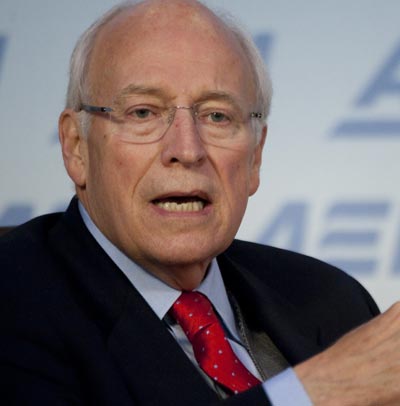
 WASHINGTON: Former US vice president Dick Cheney was in hospital Sunday, recovering after a long-awaited and "lifesaving" heart transplant from an unknown donor to whom he will "be forever grateful."
Cheney, 71, a central figure in the "war on terror" launched by the United States in the wake of the September 11 attacks and who remains a prominent figure in the Republican Party, has a long history of heart trouble.
He had been on a list for the transplant for more than 20 months, said a statement from his spokeswoman Kara Ahern.
Cheney, who served under president George W. Bush, "is recovering in the intensive care unit ofInovaFairfaxHospitalinFalls Church,Virginia, after undergoing heart transplant surgery on Saturday," the statement said.
"Although the former vice president and his family do not know the identity of the donor, they will be forever grateful for this lifesaving gift," it added, without giving further details on his condition.
Cheney has suffered several major health scares.
He suffered his first heart attack in 1978 at the age of 37 and underwent quadruple bypass surgery in 1988. He has since had two artery-clearing angioplasties and in 2001 was fitted with a pacemaker.
In a 2011 interview with NBC News, he said a special pump implanted in his heart the previous year was "a miracle of modern technology" that had kept him alive but was a "temporary measure."
In a long political career Cheney served in Congress, the White House and as defense secretary, but gained real prominence while vice president.
He was a driving force behind Bush's foreign policy after September 11 when three civilian jetliners were hijacked and flown into theWorldTradeCenter, the Pentagon, and of a fourth that plummeted into a field inPennsylvania.
Almost 3,000 people were killed in the attacks and Cheney was heavily involved in the subsequent decisions to invadeAfghanistan, in autumn 2001, andIraqin March 2003.
The White House response after September 11 also included controversial measures such as the wiretapping of US citizens without a warrant and the use of harsh interrogation methods that met global definitions of torture.
Despite his persistent health problems, Cheney has remained a key Republican figure since leaving office, often criticizing President Barack Obama.
Last May, however, Cheney said Obama "deserves credit" for theUScommando raid inPakistanthat killed the Al-Qaeda leader Osama bin Laden, whom the Bush administration failed to find and eliminate despite a decade-long search.
Cheney's book released last year, "In My Time: A Personal and Political Memoir," criticized members of the Bush administration including then secretary of state Colin Powell.
Bush, in his 2010 memoir "Decision Points," admitted that he had considered dropping Cheney ahead of his re-election run in 2004, but instead chose to defend his vice president as well as the invasion ofIraq.
Bush wrote that he spent weeks considering an offer by Cheney to drop him from his eventually successful re-election ticket, saying his vice president was seen as "dark and heartless the Darth Vader of the administration."
Under Bush, Cheney advocated an aggressive use of executive power, believing the president should be able to operate almost unfettered by lawmakers or the courts, particularly during wartime.
The approach attracted little criticism immediately after the deaths on September 11, asUSlawmakers supported military action months later inAfghanistanand the detention of suspected terrorists atGuantanamo Bay,Cuba.
But as prisoner abuse emerged at Abu Ghraib prison in the later war inIraq, Cheney was increasingly painted as a shadowy figure responsible for pushing a radical national security agenda.















Comments
Comments are closed for this article.