

Sindh police chief A D Khwaja said on Tuesday that those responsible for targeted murders of police officials were still sitting in the institutions while inaction against them alongside silence of the society had demoralised the police that single-handedly conducted operation against criminals in Karachi in the 1990s.
He said this in a complaining tone in response to objections raised by office bearers of Karachi Chamber of Commerce and Industry (KCCI) and other traders regarding the poor performance of the police department. "It was Sindh police that executed Karachi Operation single-handedly in 1990s. Unfortunately, political colour was given to the operation and consequently, hundreds of officials who took active part in the operation were brutally killed on roads and alleys," he said, adding that this atrocious trend profoundly discouraged policemen.
He lamented that the entire society became silent spectator instead of raising voice in favour of police. He said had the people played pro-police role, the situation would not have been what it is today. On this a journalist asked what action police chiefs had taken against those responsible, so far, but Khwaja parried the query saying he didn't want to create any sort of controversy. Instead, he claimed confidently that the culprits involved behind the targeted murders of the personnel of military, rangers and police in Karachi were arrested by the police.
He said the 1861 Police Act was the main obstacle in running the department's operational and administrative affairs, independently because Sindh police department was still functioning in accordance with that law. "The enforcement of the 1861 Police Act was actually aimed at suppressing the people of the subcontinent by the British (colonial) rulers. It had nothing to do with public service." he said, without highlighting the relevant flaws.
However, he said, as long as the law of that colonial era is not changed, it is impossible for police force to improve performance. "We have got quite different challenges in the 21st century as compared to 1861," he said requesting the KCCI and civil society to back this demand to replace the obsolete Police Act 1861 with a new Police Act which must focus on transforming police from 'police force' to 'police services'.
IG Sindh Police proposed to the KCCI to form a focal committee in association with Police Department to discuss and identify law and order issues, jointly that will help police devise strategy to deal with numerous issues particularly the rising street crimes.
He further said that to deal with the politicisation of police department, he has taken some irreversible steps, of which the most important step is the recruitment of officers through the Pakistan Army in association with CPLC and only those officers were being recruited purely on the basis of merit who qualify NTS exams. He said that a batch of 4,000 officers would be completing their training by Pakistan Army on Friday, February 10, whereas another batch of 15,000 officers will be sent for training on February 15. He said this particular step, besides dealing with the issue of politicisation, will provide some of the best and well-trained officers to police department.
Khwaja further said that all police stations across Karachi were currently being equipped with a reasonable reporting room to facilitate public which would be completed by June this year while the Driving License Office in Clifton had become completely automated, resulting in improving its working. He said steps were being taken to improve other driving license facilities in other parts of Sindh. He wished that the licenses issues from Sindh should be accepted globally.
Referring to President KCCI's remarks, IG Sindh Police immediately announced granting 6 hours of leniency period to those citizens who were not carrying original documents. "No FIR or legal action will immediately be taken against such commuters and if they produce the original documents within six hours, they will be freed," he assured.
Chairman BMG and former President of the KCCI, Siraj Kassam Teli, said that any police officer including SHOs, DSPs, SSPs, and DIGs etc, who is determined and have strong faith, would surely be able to improve the performance of the police department within available resources and specially under present circumstances.
He was of the view that limited number of police force, political pressure, low salaries, lack of funds and other excuses by police department might have been valid but, the police officers can deliver positive results if they perform their duties more dedicatedly and honestly, despite hurdles.
Referring to the state-of-the-art technologies being used in the United Kingdom to track anyone through SIM card, he stressed that Sindh police should also get such technology to track any culprit within 2 hours by swiftly analysing all the SIM Cards being used within a specific radius of the crime scene.
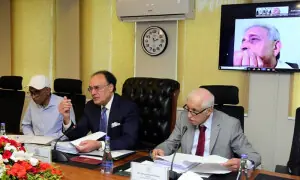
"Unfortunately, some elements were hesitant to introduce such efficient technologies in Pakistan because they want to hide their own embezzlements," he said. Karachi police chief Mushtaq Maher, vice chairman of BMG Zubair Motiwala, president of KCCI Shamim Ahmed Firpo, senior vice presidents Asif Nisar and Muhammad Younus Soomro and others were also present.
















Comments
Comments are closed for this article.