

US stocks plunged on Monday and investors fled to the safety of gold and bonds after the downgrade of the US credit rating by Standard & Poor's stoked fears the United States is slipping into recession. Walls Street tumbled on Monday, with the S&P down more than 6 percent for its largest drop in nearly three years on rising fears of a recession exacerbated by the United States' loss of its triple-A credit rating.
Panicked selling on heavy volume resulted in the S&P 500's worst day since December 2008 with every stock in the benchmark index ending in negative territory. The Dow Jones industrial average dropped 634.76 points, or 5.55 percent, to end unofficially at 10,809.85. The Standard & Poor's 500 Index sank 79.92 points, or 6.66 percent, to finish unofficially at 1,119.46. The Nasdaq Composite Index lost 174.72 points, or 6.90 percent, to close unofficially at 2,357.69.
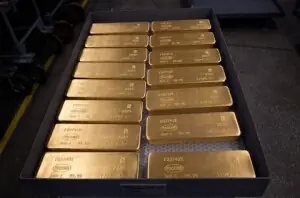
Oil plunged 5 percent on Monday, crashing below technical support levels as the reduction of the top-tier US credit rating hammered markets and stoked concerns of an economic slowdown. Gold surged more than 3 percent on Monday, surpassing $1,700 an ounce for the first time. Spot gold was up 3.1 percent at $1,714.09 an ounce by 2:39 PM EDT (1839 GMT), having hit a record $1,719.99 earlier and marking all-time highs against sterling and euros.
Brent crude dropped $5.63 to settle at $103.74 a barrel, substantially below the 200-day moving average of $106.89 that it had managed to settle above on Friday. US crude traded down $5.57 to settle at $81.31 a barrel, the lowest close since November 23. It then dropped as low as $80.17 a barrel in post settlement activity
Investors were struggling to discern the effects of the US credit rating downgrade to AA-plus from AAA, which could hit various components of the vast US financial sector, from mortgage lenders to municipal issuers and insurers. "This is all a new trading paradigm, no one has ever experienced anything like this before. It's going to take the market and investors a couple of days to comprehend what is actually happening," said Dean Popplewell, chief currency strategist at Oanda in Toronto.
"We have just seen panic liquidation - does it have the legs to continue is obviously the next question." Investors took shelter in the asset that was downgraded - choosing US government bonds for their liquidity and perceived high quality. The downgrade - and threats of subsequent moves by S&P or other rating agencies - raises uncertainty about the credibility of the United States in the global economy as investors worry about another recession. Central to S&P's argument was that political paralysis in Washington has reached a point where the government would be unable to deal with worsening deficits and sagging economic growth. This burdens a stock market already skittish after last week's outbreak of fear.
US President Barack Obama blamed the downgrade on political gridlock in Washington and said he would offer some recommendations on how to reduce federal deficits. "In many ways this is not about the downgrade. I think it's about the underlying fundamentals and issues that are embodied in the downgrade itself," said Jonathan Golub, chief US equity strategist at UBS in New York.
MSCI's all-country world stock index dropped 4.6 percent to its lowest since September 2010. The sell-off since July 29 has wiped at least $3.4 trillion off the value of global stocks, the equivalent of Germany's gross domestic product. Monday's rush for the exits extinguished any relief from news the European Central Bank was buying Italian and Spanish government bonds in the latest move to staunch the eurozone debt crisis.
Several major brokerages have in recent days lowered their expectations for US economic growth and share appreciation for 2011 and 2012. Moody's repeated a warning it could downgrade the United States before 2013 if the fiscal or economic outlook weakened significantly. It said it saw the potential for a new deal in Washington to cut the budget deficit before then.
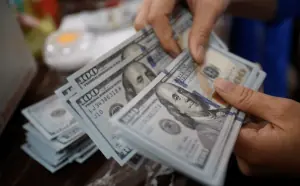
Investors looking for a safe place to park their money pushed gold to a record high above $1,700 an ounce. The US dollar dropped against the Swiss franc and yen. The euro fell against the dollar. The euro hit a record low against the Swiss franc, falling as low as 1.0640 Swiss francs. It also lost 2 percent versus the yen. The dollar fell 0.6 percent to 77.62 yen and was down 1.8 percent at 0.7538 Swiss franc. Benchmark 10-year Treasury note yields fell to their lowest levels since February 2009. The notes rose over two points in price, with yields falling as low as 2.33 percent, the lowest rate in two-and-a-half years.
European shares closed down 4 percent after registering gains on the ECB action. The FTSEurofirst 300 index has lost about 21 percent since a peak in mid-February, putting it in bear market territory. There have been 26 other days since 2000 when the market has been down more than 3 percent at noon, according to Birinyi Associates Inc. On average, 85 percent of the time the market continues lower until the close for a further 1 percent fall.



















Comments
Comments are closed for this article.