


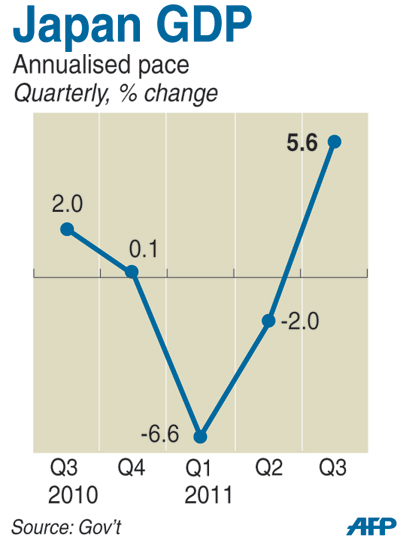
 TOKYO: Japan said Friday its economy grew less in the third quarter than an initial estimate, dented by the strong yen and fears the eurozone crisis will weigh on a fragile post-quake recovery.
The Cabinet Office said the economy grew by an annualised 5.6 percent in the July-September quarter -- lower than 6.0 percent announced last month -- with a government spokesman saying growth was "moderating."
However, the figure represents Japan's first economic expansion in three quarters, as the country recovers from the March 11 quake and tsunami disaster with manufacturers ramping up production.
And the monthly outcome still beat analysts' expectations for a revised 5.2 percent gain, according to Dow Jones Newswires.
On an on-quarter basis, gross domestic product growth was 1.4 percent in July-September, revised down from 1.5 percent, government figures showed.
Authorities have been cautious about the prospects for Japan's economy, saying weakness in key US and European export markets could dash hopes for a sustained recovery.
"The data confirmed that business sentiment has been dampened by a stronger yen and uncertainties about the global economy," said Satoshi Osanai, economist at the Daiwa Institute of Research.
The downward revision was expected after the government said last week it was lowering its capital spending estimate, a key figure in calculating gross domestic product.
On Thursday, official data showed Japan's core private-sector machinery orders, a leading indicator of corporate capital spending, fell 6.9 percent in October from the previous month.
Economists were also concerned that private consumption, which accounts for about two-thirds of Japan's GDP, was revised down to a 0.7 percent on-quarter rise, from an initial estimate for a 1.0 percent increase.
Last month, Bank of Japan governor Masaaki Shirakawa warned the country would continue to face a "severe situation" and that Europe's sovereign debt crisis was the biggest risk factor in any recovery.
The crisis has also been a key issue behind Japan's surging yen, which investors have flocked to as they seek a safe-haven currency.
The yen's rise to post-World War II highs against the dollar has prompted the central bank to intervene in foreign exchange markets to bring down the unit's surging value, which erodes exporters' profits and makes Japanese goods less competitive.
Japan fell into a trade deficit in October, reversing a year-earlier surplus, as the eurozone debt crisis and a strong yen weighed on exporters, while record flooding in Thailand pounded the operations of Japanese automakers and electronics firms with plants in the country.
Toyota and others withdrew earnings forecasts as they assessed the scale of disruption, which came as Japanese firms were near to restoring output to normal levels at home after the quake-tsunami shattered component supply chains.




















Comments
Comments are closed for this article.