


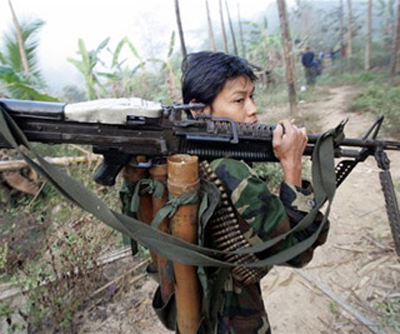
 BANGKOK: Myanmar's bid to reach out to ethnic guerrillas as part of budding reforms has raised cautious hopes of an end to decades of conflict, but analysts say major challenges must be overcome to achieve peace.
The military-dominated nation's new nominally civilian government last month sent an envoy to hold peace talks with several armed ethnic groups waging a long struggle for greater autonomy and rights.
On Friday, a ceasefire deal was inked between one of the biggest militias still battling the regime -- the Shan State Army South -- and local authorities in the northeastern state, and mediators have expressed hopes of other truces.
The developments are welcome in a country that has been wracked by civil conflict -- and human rights abuses involving government troops -- in ethnic areas since Myanmar became independent from British rule in 1948.
The peace moves "mark one of the most significant moments in the six decades of conflict," the think-tank International Crisis Group (ICG) said in a recent report, while adding that "lasting peace cannot be assured".
Ethnic minority grievances run deep and the regime must address the concerns of all groups, including those not pursuing armed struggle, it said.
In eastern Karen State, rebels have been waging one of the world's longest insurgencies, battling the government in a region now littered with landmines. Tens of thousands of refugees have fled across the border to Thailand.
Bloody fighting has also raged since June in northern Kachin State, where there has been resentment of Chinese backed hydropower projects.
In a rare response to public opposition, Myanmar's president in September suspended construction of a controversial mega-dam in Kachin.
But heavy fighting has continued daily in the state bordering China since November's peace talks, according to Colonel James Lum Dau of the Kachin Independence Organisation (KIO), whose group attended the meeting.
He accused Myanmar's military of deploying more troops and using chemical weapons -- an allegation that could not be independently verified -- in their battles in Kachin, which have forced tens of thousands to flee their homes.
"That meeting was only to get pictures to show (US Secretary of State) Hillary Clinton," said Lum Dau, who is based in Bangkok, having initially expressed optimism over the talks.
On her landmark visit to the country last week, Clinton welcomed what she said were efforts by the regime to resolve ethnic conflicts, after talks with the country's rulers.
But throughout Clinton's visit -- the first by such a high level US politician in 50 years -- US officials said they expected the ethnic fighting to be one of the most difficult issues for Myanmar to resolve.
"There can be no true peace or justice until it is shared by everyone, in every part of this beautiful, diverse country," Clinton told a news conference.
While she acknowledged progress on reforms in areas such as Yangon, "terrible violence continues elsewhere, especially in some of the ethnic nationality areas, which, in addition to the continuing conflicts, suffer from unacceptably high rates of poverty, disease and illiteracy".
Myanmar's democracy icon Aung San Suu Kyi -- sometimes distrusted by ethnic minorities -- also put a priority on the conflict issue, calling for an immediate cessation to violence in ethnic areas.
The International Crisis Group argued that lasting conflict resolution "should not become another benchmark" for improved relations with the West or the lifting of sanctions.
"There are far better diplomatic tools available to keep a focus on the ethnic conflict," the report said, calling for changes including reform of the armed forces and strengthening domestic accountability.
One key question is how far the regime will go in accommodating the ethnic minority groups' desire for greater autonomy.
There is also deep distrust of government troops in ethnic conflict zones, where rights groups have documented numerous allegations of abuses including rape and forced labour.
Mediators say the authorities are also trying to reach peace agreements with the Karen National Union, the Chin National Front and the Karenni National Progressive Party, as well as the KIO, thought to be the most sceptical.
But mere "gentlemen's agreements" would not settle political issues, according to Renaud Egreteau, a Myanmar expert at the University of Hong Kong.
"Continuing negotiations with real policy proposals is far more complicated and you may see, alas, many differences among the ethnic minorities over strategy," he told AFP.




















Comments
Comments are closed for this article.