


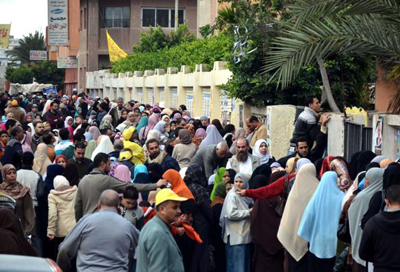
 CAIRO: The interim army rulers in post-revolution Egypt have successfully overseen the start of elections, but they and the country at large face huge challenges ahead, analysts said.
The long orderly queues in Cairo and the Mediterranean city of Alexandria on the first day of parliamentary elections were a triumph after the violent scenes of last week when 42 people died in unrest that threatened the vote.
"The people and the armed forces should consider November 28 a celebration for the Egyptian people," Mohammed al-Assar, a member of the ruling Supreme Council of the Armed Forces, said on Tuesday.
The SCAF led by Field Marshal Hussein Tantawi stuck defiantly by its timetable to hold the first stage of elections on Monday and Tuesday despite the violence and calls for a delay by some political groups.
The bet on support for the poll from the "silent majority" -- as opposed to the noisy democracy activists who demonstrated last week -- appears to have paid off.
"It's a success for the people and a success for the army, which has played the election card to stabilise the country in the face of pressure from the street," said Tewfik Aclimandos, an expert at the College de France, an academic institute.
The army had recently thrown into doubt its desire for genuine political reform as it proposed measures that would see it have a final say on all future military-related legislation and have its budget shielded from public scrutiny.
The proposals brought tens of thousands back to Tahrir Square in Cairo, the epicentre of the uprising that toppled autocrat Hosni Mubarak in February, leading to the violence last week.
But the elections -- which have quietened Tahrir, at least temporarily -- could be the start of other problems for the military, viewed with suspicion by some.
A parliament "with a strong popular legitimacy can also in the future challenge the power of SCAF," said Karim al-Assar, an analyst with Cairo-based independent Signet Institute.
It is unclear if the current army-appointed cabinet will stay in place or whether the new assembly will be able to pick a new government. The final results for the lower house of parliament will be published on January 13.
Voting for the lower house is taking place in three stages beginning in the main cities of Cairo, Alexandria and other areas, with the moderate Islamist group the Muslim Brotherhood expected to triumph.
SCAF member Mamduh Shahin recently said the new parliament would have no authority over the government, but a strong win by the powerful Brotherhood could set up a fierce battle for influence.
Tantawi last week appointed a Mubarak-era leader, 78-year-old Kamal al-Ganzuri, to head the new caretaker government, fanning the flames of anger in Tahrir Square.
Another danger is the long and complex voting procedure for the new parliament that will only end only in March when both upper and lower houses have been elected in at least six rounds of voting.
After a new constitution is drawn up -- likely to be bitterly contested in the fragmented parliament that is set to emerge -- presidential elections are to be held no later than June 2012.
"The battle of the constitution is only just beginning," said Aclimandos.
Ezzedine Choukri-Fishere, professor of political science at the American University in Cairo, said the electoral process was "ill-designed, the length is a hazard.
"The risks are greater in rural and remote areas," he added. "Many things can happen and every round is a challenge."




















Comments
Comments are closed for this article.