


 ISLAMABAD: Pakistan wants the commencement of negotiations on Fissile Material Cut-Off Treaty (FMCT) at the Conference on Disarmament (CD) with existing stocks explicitly included in the negotiating mandate and India's entire civilian nuclear programme brought under IAEA safeguards.
"It is incumbent on us to stand up for our own interest. We want an assurance that India's whole three stage nuclear power programme would be under safeguards. Till the time we get these assurances, we will not agree to FMCT. Assurances have not been given so far," Director General Disarmament at the Foreign Office Kamran Akhtar said.
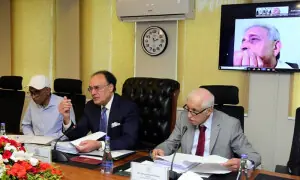
He was speaking at a roundtable discussion on `The FMCT Debate in Conference on Disarmament (CD) and Pakistan's Perspective' here at Strategic Vision Institute (SVI), which specializes in non-proliferation and disarmament issues, said a press release issued on Monday.
The discussion was organized in view of the upcoming deliberations at the CD on its programme of work and other important engagements, including the high-level FMCT experts preparatory group meeting.
Kamran Akhtar said the Pakistani position had been that negotiating a treaty that only bans future production of fissile material without taking into account the existing stockpiles, would freeze the existing asymmetries.
This, he said, would put Pakistan at a permanent disadvantage and undermined its security interests. The discriminatory waivers given to India and the bilateral civil nuclear cooperation agreements New Delhi had signed with a number of countries added to Pakistan's security worries.
He said eight of Indian reactors, its fast breeder programme, and approximately five tons of reactor grade plutonium were not under the safeguards of International Atomic Energy Commission (IAEA).
It was feared that the reactors that were not under safeguards might be clandestinely used for plutonium production and the existing stockpiles might be diverted to military programme at a subsequent stage, he added.
Kamran Akhtar said, "Pakistan should not be asked to agree to something that is not in its strategic interest.
"We have to factor into consideration possible actions by India that could undermine credibility of our nuclear deterrence."
Dr Mansoor Ahmed, a post doctoral fellow at Harvard University's Belfer Center, observed that Pakistan was not engaged in a classic cold war type arms race but was striving for maintaining the credibility of its deterrent.
That quest, he noted, was a dynamic process in response to destabilizing technological, doctrinal and force posture developments in India.
"It's striving for balance, not parity with India," he asserted and reminded that India was pursuing the fastest growing fissile material expansion and conventional and strategic force modernization outside the NPT (Non-Proliferation Treaty) states, besides moving in the direction of a first strike option coupled with a review of their No-First Use policy.
Dr Mansoor said that India's development of BMD shield and MIRVs for their Agni missiles and also for SLBMs along with its other emerging conventional and nuclear counterforce capabilities were straining Pakistan's deterrence, forcing it to take appropriate countermeasures.
















Comments
Comments are closed for this article.