


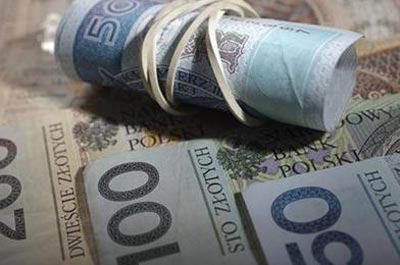
 BUDAPEST/WARSAW: The zloty and Polish government bonds firmed amid hopes that Moody's will only worsen the outlook of Poland's credit rating later on Friday rather than cutting the rating itself.
In January, rating agency S&P downgraded Poland's credit rating, saying the ruling conservative government had weakened the independence of key institutions, particularly the constitutional court. There are fears now that government spending plans and other political measures could prompt a downgrade by Moody's as well on Friday.
In a Reuters poll, most analysts forecast that Moody's will cut Poland's credit rating outlook to negative from stable. A minority saw a rating cut to A3 from A2.
But some investors think that even a downgrade could not weaken the zloty further as it got oversold in the past weeks and reached a 3-month low against the euro last week.
It traded at 4.4 at 0847 GMT, firmer by 0.4 percent, with the expectations on the ratings mostly priced in.
Polish government bonds firmed, with yields falling 3-5 basis points along the curve. The yield on the 10-year benchmark paper dropped 3 basis points to 2.97 percent.
"If only the outlook is downgraded, there might be no reaction (in markets) at all ... Rating cut will obviously be negative for the zloty, likely not only in short term," mBank analysts said in a note.
Polish debt yields have been falling for days, partly due to hopes that the rating will not be lowered. If the rating is not lowered, bonds' potential for further gains might be limited, analysts said.
"In our opinion, if the agency only downgrades the outlook to negative, 10-year bond yield could fall to 2.95 percent within a week," BZ WBK analysts said in a note.
Elsewhere in Central Europe, the forint also firmed slightly, by 0.1 percent to 315.50.
It rebounded from a 4-month low hit earlier at 316.4, after Hungary reported a sharp slowdown in economic growth to 0.9 percent in the first quarter from 3.2 percent in the previous quarter, due to a decline in construction and the country's vehicle industry, and a slowdown in the inflow of EU funds.
The figures were the worst since 2012, but analysts said some pick-up was likely later this year.
"Against this background, recently announced fiscal easing may support the already weak growth prospects," ING analyst Peter Virovacz said in a note.
The index of the Budapest Stock Exchange, however, fell half a percent.
The stocks of OTP Bank, which is sensitive to economic output, fell 1.3 percent even though the region's biggest independent lender reported a jump in first-quarter profits.
Polish figures also showed a slowdown in economic growth, to 3 percent, its lowest in more than two years.
That negative surprise also contributed to the fall in Polish bond yields as it could increase the probability that the Polish central bank will resume interest rate cuts, traders said.
Warsaw's bluechip stock index shed 0.1 percent.




















Comments
Comments are closed for this article.