


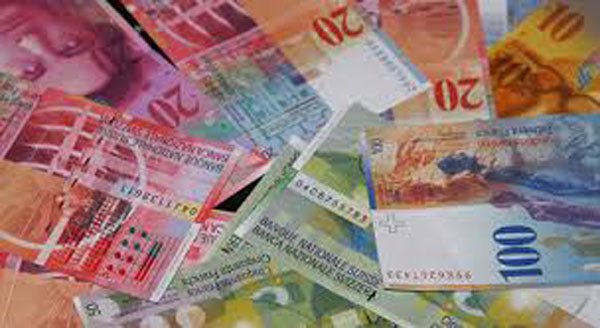
 ZURICH: Switzerland intends to cut debt for a ninth consecutive year, trimming it to less than 74 billion Swiss francs ($74.21 billion) by the end of next year from nearly 96 billion francs in 2007.
Taking into account maturing issues, Switzerland's plan to issue 6 billion francs in new treasury bonds in 2016 will cut debt by another 3.4 billion francs, the Swiss National Bank and the Swiss Treasury said in a joint statement on Tuesday.
After Switzerland's federal debt peaked above 25 percent of gross domestic product in the 1990s, lawmakers introduced a brake on borrowing in 2003. Since then, it has gradually diminished, a trend set to continue next year.
Officials are also seeking to capitalise on low interest rates and Switzerland's reputation for safety to guarantee cheap borrowing costs for years to come. So far, the strategy is working, with the average bond maturity of about 20 years and an average interest rate of 0.38 percent, said Philipp Rohr, a Swiss Treasury spokesman.
"We will continue to follow the strategy of trying to lock in low interest rates for as long as possible," Rohr said. "We've already got a bond of nearly 50 years."
That bond, maturing in 2064, yields around 0.76 percent . Ten-year government debt now yields less than zero: around -0.25 percent, according to Thomson Reuters data. Investors generally buy and hold the country's long-term bonds until maturity, resulting in a limited secondary market.
Consequently, the SNB has little scope for quantitative easing - buying state bonds from financial institutions - to weaken its currency or stimulate its economy, as the European Central Bank and US Federal Reserve have done.
The SNB and Swiss Treasury also said they are aiming for total registered money market claims, used to meet shorter-term liquidity needs, to reach 8 billion to 9 billion francs by the end of 2016, up from about 6 billion to 7 billion francs in 2015.
With negative interest rates a pillar of the SNB's effort to curb what it calls a "significantly overvalued franc," investors paid Switzerland 70 million francs in 2015 on money market claims.
"The negative interest rates, for many people, are almost like an insurance premium that they pay for certainty that they've put their money in a safe place," Rohr said.




















Comments
Comments are closed for this article.