

China Vice Premier reaffirms "prudent" monetary policy

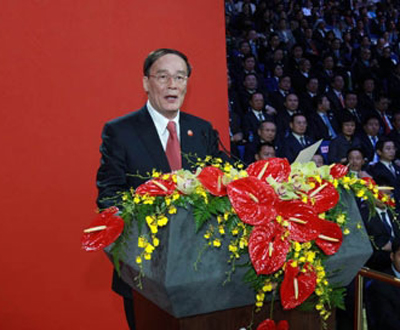 BEIJING: Chinese Vice Premier Wang Qishan reaffirmed Beijing's "prudent" monetary policy in remarks published on Monday, and stressed the need for banks to increase support for small firms and the agricultural sector.
Despite recent global market turbulence due to worries about sovereign debt issues and a possible recession in the United States and Europe, China has so far maintained its monetary policy stance, although investors have noticed a slower pace of tightening.
The central bank has refrained from raising banks' required reserves after increasing them once every month in the first half, and it last raised interest rates on July 6, the third time this year.
"Confronted with the extremely complicated and uncertain global economic situation currently, the key is to successfully do our own jobs," the official China Securities Journal cited Wang as saying during a weekend visit to the northwestern Gansu province.
"We must carefully handle the relationship between maintaining stable and fast economic growth, adjusting economic structure, and managing inflationary expectations, and carefully implement the prudent monetary policy," Wang said.
He urged banks to meet reasonable financing demand from small companies and the agricultural sector and also reminded them not to expand blindly across the regions.
Wang added that the country would also need to closely monitor the private lending market as well as banks' wealth management services, through which Chinese lenders take loans off balance sheets.
In a separate article in the same newspaper, a Chinese government economist urged a timely shift in monetary policy to steer growth in the aftermath of the US debt crisis.
"What China needs to do now is to add heat to the domestic economy, instead of continuing to cool it down," said Wang Jian, a researcher with the National Development and Reform Commission, China's top economic planner.
Otherwise, weakening external demand and slowing domestic investment would make it difficult for China to safeguard an annual economic growth rate of 7 percent, let alone 8 percent, he warned.
Without adjustments, more small companies would become bankrupt, leading to rising unemployment and various social problems, he warned.
"Looking from whichever aspects, China should end the monetary tightening policy started last year," he said.
Inflation, which hit a three-year record of 6.5 percent in July, could edge higher, but Beijing should increase subsidies for low-income families instead of tightening monetary policies further, he said.
"In the long run, China must speed up reforms to improve wealth distribution, while accelerating urbanisation. Only in these ways can China stimulate domestic demand and make sure it stands firmly amid the big global crisis," the researcher said.
Copyright Reuters, 2011























Comments
Comments are closed for this article.