

Italy delivers tough austerity measures

 ROME: The Italian government will pass a sweeping package of cuts and tax increases at a cabinet meeting on Friday as it scrambles to meet European Central Bank demands for action to shore up confidence in its public finances.
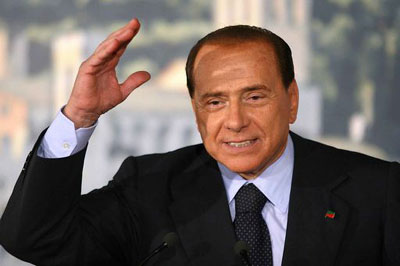
After days of criticism for a lack of clarity over how it intended to meet an ECB-imposed target of balancing the budget by 2013, Prime Minister Silvio Berlusconi's government is set to deliver a harsh dose of austerity to Italy's fragile economy.
Berlusconi told local government representatives that the cabinet would adopt austerity measures worth 20 billion euros in 2012 and a further 25 billion euros the following year through a mixture of public spending cuts and higher taxes.
Funding to regions and local governments would be cut by 6 billion euros in 2012 and 3.5 billion in 2013, while budgets for government ministries in Rome will be cut by 6 billion euros in 2012 and 2.5 billion in 2013, officials at the meeting said.
The government would glean the remaining 8 billion euros in measures for 2012 from higher VAT, a "solidarity tax" on high earners and rising the pension age, Roberto Formigoni, governor of the Lombardy region, told reporters after the meeting.
Earlier, Berlusconi's office announced an emergency cabinet meeting at 7.00 p.m. (1700 GMT) to pass the measures and reassure panicked financial markets the government can control public debt running at 120 percent of gross domestic product.
But the planned cuts were bitterly criticised by regional leaders who say local services from transport to health and welfare services have for years borne the brunt of austerity measures imposed by central governments in Rome.
"For us, the fiscal measures which have been proposed are absolutely unjust," said Giuseppe Castiglione, head of the Union of Italian Provinces. "When you talk about municipalities, you're talking about social services, when you talk about provinces, you're talking about schools, security at school, local roads," he said.
The extent of the cuts underline how far the government has been pushed since markets turned on Italy last month, dragging it close to a Greek-style emergency that would overwhelm the euro zone's bailout mechanisms.
The market turbulence which threatened to send borrowing costs out of control last week has eased after the ECB stepped in to buy Italian bonds, but heavy falls on the stock market have underlined the persistent fear among investors.
On Friday, bourse regulator Consob announced a temporary ban on short-selling financial stocks to try to calm the volatility that has hammered Italian bank shares. The main Milan index traded more than 2.5 percent higher on Friday.
Despite its huge public debt, Italy, the euro zone's third largest economy, had largely kept out of the crisis until last month when doubts about the government's unity and capacity to control finances triggered a big selloff of Italian bonds.
Its ability to cut the debt has been held back by a growth rate which has been among the worlds slowest over the past decade. Analysts say the austerity package promised on Friday could squeeze investment and consumer demand even further.
That risks stirring anger among Italians struggling to get by and could bode ill for an economy which has made up only two of the seven percentage points in output lost in the 2008-09 recession.
The government has rejected the idea of a "wealth tax" on private assets but the planned "solidarity tax" on high earners is clearly aimed at showing that sacrifices are being shared.
Business daily Il Sole 24 Ore said the tax would take the forms of 5 percent extra-tax on income above 90,000 euros and 10 percent more tax on income above 150,000 euros.
Additional measures could include a rule ensuring that non-religious public holidays, such as the June 2 anniversary of the founding of the Italian Republic, are celebrated on a Sunday to increase the number of working days in a year.
It is still not clear how retirement ages may be extended. Possibilities include rising the retirement age for women working in the private sector and curbing the extensive system of early retirement based on pension contributions.
On Thursday, Tremonti told a parliamentary committee the ECB had asked for a series of measures to break down barriers to competition in services and closed professions and free up rigid labour market rules.
The recommendations included full liberalisation of local public services and the professions, more flexible employment contracts, easier hiring and firing and public sector pay cuts.
Tremonti said the proposals on hiring and firing and cuts to public sector pay, both of which would raise fierce political opposition, were not in the government's plans.
Copyright Reuters, 2011






















Comments
Comments are closed for this article.