

Merkel, Sarkozy seek eurozone breakthrough

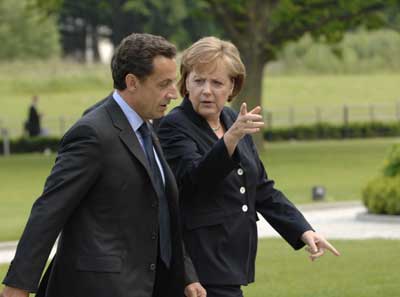 BERLIN: Germany talked up Wednesday the chances of a breakthrough in the eurozone debt crisis after a raft of dire warnings and jitters on financial markets a day ahead of a crunch summit.
"Germany and France must agree. If this does not happen then we can't make progress in Europe," Chancellor Angela Merkel's spokesman ahead of talks in Berlin with French President Nicolas Sarkozy.
"There is confidence on both sides that such a common line can be worked out this evening," Steffen Seibert said, adding Merkel was "very confident" Thursday's Brussels summit would produce a "good result."
The two leaders went into talks followed by a working dinner late Wednesday. It was unclear if there would be a statement afterwards. Both were due to travel to EU headquarters in Brussels from the German capital on Thursday.
The comments from Berlin, which has come under fire from all sides for its handling of the eurozone debt crisis, marked a change of tone after Merkel played down on Tuesday any expectations of a "spectacular" summit outcome.
Berlin has been at odds with Paris and the European Central Bank over the terms of a second bailout for Greece, a year after Athens received a first 110-billion-euro ($154-billion) package that has proved insufficient.
Nervous financial markets are awaiting the outcome of the summit after several rocky days, with debt crisis contagion threatening to engulf Italy and Spain, the eurozone's third and fourth-largest economies.
"Nobody should be under any illusion -- the situation is very serious," European Commission President Jose Manuel Barroso warned.
"It requires a response. Otherwise the negative consequences will be felt in all corners of Europe and beyond."
In Paris, French government spokeswoman and Budget Minister Valerie Pecresse said: "We have one priority, an urgent one, which is to find a lasting solution to the Greek question."
The embattled Greek government said the meeting "will determine the future of Greece and of Europe."
The International Monetary Fund, a contributor to bailouts of Greece, Portugal and Ireland, urged eurozone leaders to take urgent action, warning any delays "could be costly for the euro area and the global economy."
New IMF chief Christine Lagarde of France will attend the Brussels summit in her first international appearance as the global lender's managing director since she succeeded compatriot Dominique Strauss-Kahn on July 5.
US President Barack Obama discussed the crisis in a phone call with Merkel on Tuesday. The White House said they had agreed that "dealing effectively with the crisis" was important not only for Europe but also for the global economy.
Berlin insists that private creditors, not just taxpayers, must shoulder some of the costs of a new bailout, even if it means triggering some sort of Greek default, an outcome vehemently opposed by the ECB, France and others.
According to the Financial Times Deutschland (FTD) daily, Merkel and Sarkozy failed to overcome their differences in a phone call on Tuesday.
The German leader was sceptical about French proposals to get the financial sector to contribute by way of a bank levy and on a wider role for the European Financial Stability Facility (EFSF), the FTD said.
One option being discussed would be for the EFSF to lend Greece money with which it can buy back its own bonds, thereby slashing it debt levels.
On Wednesday, a senior panel advising the German government said it supported such an idea, along with a substantial "haircut" on Greek debt. Merkel's spokesman said only she had "taken note."
The ECB's chief economist Juergen Stark said in a Boersen-Zeitung interview to appear Thursday that such a scheme might work but that markets would likely still feel Athens had defaulted.
Capital Economics said the fact that a bank levy was being discussed "suggests that eurozone policymakers are more concerned about appeasing taxpayers than adopting bold and decisive measures."
Copyright AFP (Agence France-Presse), 2011


















Comments
Comments are closed for this article.