


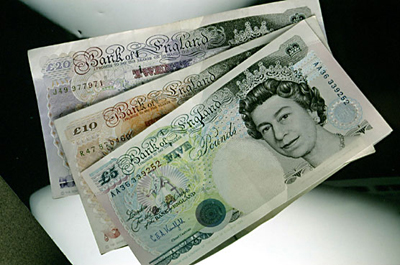
 LONDON: Sterling fell to intraday lows against both the dollar and the euro on Wednesday after data showed UK industrial and manufacturing output grew less than expected in June.
The pound, one of the main losers against a resurgent dollar in the past month, extended losses to be a third of a percent down on the day at respectively $1.6841 and 79.39 pence per euro.
It had surged more than 10 percent against a basket of currencies, and as much as 15 percent against the dollar, in the year to the start of July. But a cooling of expectations of an early rise in UK interest rates along with the dollar's broad strength have halted the rally.
"We continue to like sterling against the euro, but we are starting to become more focused on the downside risks," said Michael Sneyd, a strategist with BNP Paribas in London.
"Sterling is still the biggest long in the G10 space so it is very susceptible to even small downside surprises on data."
Some nerves around Scotland's Sept. 18 referendum on leaving the United Kingdom have also begun to creep into UK markets, but the leader of the independence campaign, Alex Salmond, failed to land victory in a set piece debate on Tuesday.
Sneyd said BNP had made a handful of trading recommendations to clients based on the expectation that the pound would prove softer, at least against the dollar, in the next few weeks.
It touched a low of $1.6825 after the output data, within sight of a one-month trough reached earlier this week, before recovering slightly.
Gilt futures extended gains by around 5 ticks after the numbers and were last up 34 ticks on the day at 111.39.
While the Bank of England is still widely expected to be the first major central bank to raise rates as economies recover further from five years of financial turmoil across the globe, there is growing evidence that Britain's upturn is peaking.
The output data added to signs that the economy is still being driven mostly by its massive services sector, again frustrating hopes for a more balanced recovery. Output for the industrial sector as a whole rose 0.3 percent in June, lagging a forecast of 0.6 percent in a Reuters poll of economists, and compared with a fall of 0.6 percent in May.
"There has clearly been an ebbing of confidence in the rate trajectory that markets had earlier priced in to sterling," said Neil Mellor, a strategist with Bank of New York Mellon in London. "It is not the star it was."




















Comments
Comments are closed for this article.