

Stalwarts in legal profession still term ZAB's verdict as bad one: CJ

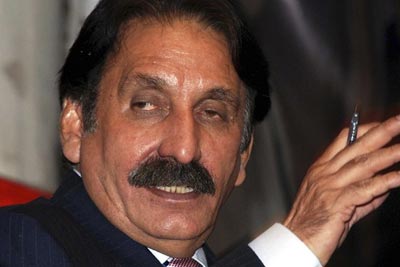 ISLAMABAD: Chief Justice of Pakistan Iftikhar Muhammad Chaudhry on Wednesday observed that a number of stalwarts in legal profession across the globe still termed the judicial verdict over late Zulfikar Ali Bhutto's case, the country'sfirst elected prime minister, as a bad one.
Heading an eleven-member bench seized with hearing of Presidential Reference sent to it by the President of Pakistan under Article 186 of the Constitution for revisiting the murder trial of late ZAB, the Chief Justice said during course of proceedings that he had travelled to US and met with Ramsay Clarke, a renowned US jurist, in New York and he was still saying that ZAB's verdict was a bad one.
"In UK and Pakistan the stalwarts associated with legal profession are condemning it (decision)," he added.
Addressing Attorney General for Pakistan Molvi Anwarul Haq during his arguments, he said that it was the most significant case as the whole world would be looking towards the Pakistan Supreme Court for a verdict over the case.
"You have filed Reference in the Supreme Court and the apex Court is at stake now. We are really thankful to the President for sending a Reference under the laws giving him the right," he added.
Expressing his dissatisfaction with the arguments of Attorney General, he said that he was sorry to observe that the bench was not properly assisted over the case, the way it wanted to be.
The Chief Justice further said that they did not want to decide the issue haphazardly.
"It is becoming a history and you people are creating it," he added.
The hearing was adjourned till date in office subject to availability of the bench and directed the Attorney General to prepare himself with arguments pertaining to questions of law involved in the case.
Citing another reason for putting off hearing of the Reference, the bench in its order noted that a number of amicus curiae in the case, Abdul Hafeez Pirzada, Fakharuddin G. Ebrahim, Mohammad Ashraf Qazi, Asma Jahangir and SM Zafar were on general adjournments.
The bench directed advocate general Punjab Khawaja Haris to submit reply over the issue of untraceable private complaint of 13 July, 1977 filed by Ahmed Raza Kasuri against late Bhutto.
At the outset of proceedings, Attorney General stated that it was Court's duty to consider questions raised in a Reference.
He said from the record it appeared that execution of the late ZAB violated the High Court rules.
The execution should take place in no less than seven days and no more than 21 days after the issuance of death warrants, he added.
The bench observed that Attorney General was repeating the same arguments as forwarded by counsel for Referring authority.
Justice Sarmad Jalal Osmani asked him how they could treat the issue of bias as question of law!
He observed that everyday they had to deal with human rights issues and examined them on basis of questions of law.
Justice Jawwad S. Khawaja guided the attorney general by saying that he could say that the issue pertained to both question of fact and question of law.
Justice Javed Iqbal to his arguments over certain Indian verdicts told him that in Indian jurisdiction, the question of fact could be referred in a Presidential Reference.
Citing relevant constitutional provisions of Bangladesh, Fiji; etc, he told him that he should compare them with the Article 186 and assist the bench how its scope could be widened over adversarial proceedings.
The Chief Justice said that the Indian Court had the curative jurisdiction in such matters.
Justice Ghulam Rabbani said that they had to form an opinion while referring to a question of law.
"We are not concerned with the verdict but we want to know which law was violated in the case," he questioned.
He said the whole world knew what was the verdict, but they had to deal with the core issue of question of law.
The Attorney General replied that the law which conferred upon him the right of fair trial was violated.
"The inherent jurisdiction to do complete justice is with you," he added.
Justice Jawwad S. Khawja remarked that if he was a member of the bench at that time, he might have concurred with the dissenting note but here they were concerned with the constitutional provision.
He told him if last five or six words from the question number 2 were not there, it could be probably a good question of law.
Khawaja Haris to bench's query replied that the record of private complaint filed by Ahmed Raza Kasuri was untraceable, however, he had asked the concerned authorities to submit detailed report.
Justice Javed Iqbal said that private complaint was kept pending with the Lahore High Court two-member bench headed by justice Samdani.
Justice Sarmad Jalal Osmani told the attorney general that he should base his arguments over the role of approver leading to execution of accused.
He told him to assist the bench whether a corroborator could be executed on basis of evidence of approver.
Copyright APP (Associated Press of Pakistan), 2011














Comments
Comments are closed for this article.