


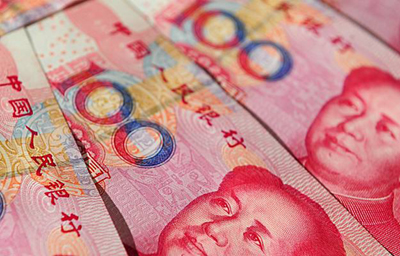
 SHANGHAI: China's yuan firmed marginally against the dollar on Tuesday despite the central bank setting a weaker mid-point, as major banks sold dollars as China's markets reopened after a holiday on Monday.
Spot yuan was at 6.2462 per dollar at midday, up 0.02 percent from Friday's close, after the People's Bank of China (PBOC) set its official midpoint at 6.1710, the weakest since Sept. 6 and 0.02 percent weaker than on Friday.
The yuan usually follows the central bank's guidance to rise or fall, but the dollar sales by major banks prompted suspicions that they were unloading the proceeds from recent initial public offerings by Chinese companies on US markets, a dealer at a Chinese commercial bank in Shanghai said.
Shares of Chinese e-commerce firm JD.com Inc soared 20 percent in their US market debut on May 22 as investors sought a piece of the China's booming online retail market, enabling the firm to raise $1.78 billion in its initial public offering.
JD.com was the eighth Chinese company to go public in the United States this year. In total they have raised $2.99 billion, way more than in 2013, when there were eight IPOs for the whole year, and they raised $884 million.
Investors were watching JD.com's performance to guage how Wall Street might receive an IPO by its much larger peer, Alibaba.
Demand for dollars will be boosted by travellers going abroad for the summer holidays and dividend payments to overseas investors by Chinese state-owned enterprises this month.
Traders thus expect a rough balance of dollar supply and demand in June, forecasting that the yuan will move in a narrow range of 6.23 to 6.27 in the month.
The latest economic data had no immediate impact on the market, traders said.
China's factory sector turned in its best performance in four months in May as export orders improved although activity still contracted, a private survey showed on Tuesday, adding to signs the economy may be stabilizing.
The final reading of the HSBC/Markit purchasing managers' index (PM) for May rose to 49.4, lower than a preliminary reading of 49.7, but up from 48.1 in April.
The PBOC has guided the yuan to fall 3.1 percent against the dollar so far this year to deter speculators from betting on a non-stop yuan rise.
Before this year's unexpected depreciation, the yuan had steadily appreciated by more than 30 percent since its landmark revaluation in 2005.
The central bank has never said it was deliberately pushing the yuan down, but currency dealers told Reuters they suspected the drop was driven primarily by China's "Big Four" state-owned banks, who bought dollars in the domestic foreign exchange market at the PBOC's behest.


























Comments
Comments are closed for this article.