

Chile ash cloud disrupts flights on two continents

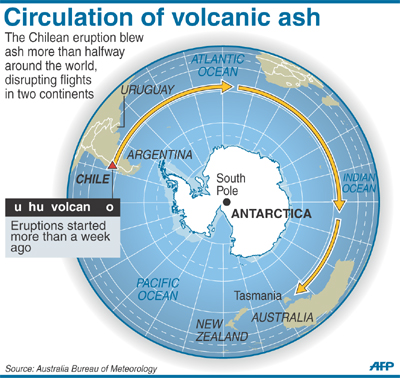 BUENOS AIRES: A volcanic ash cloud originating in Chile delayed flights across South America and Australia on Monday, stranding thousands of travelers and forcing UN chief Ban Ki-moon onto an overnight bus.
The eruption of the Puyehue volcano, high in the Andes in southern Chile, entered a second week, spewing ash that has disrupted air travel on a scale unseen since the volcanic cloud over Iceland paralyzed Europe in 2010.
Buenos Aires airports suspended domestic and international flights on Sunday night for the third time in a week, prompting a crisis meeting Monday to assess the situation, the Argentine Civil Aviation Administration said.
"Meteorological conditions have worsened again, with forecasts that the cloud of volcanic ash will remain suspended in the area over the Ezeiza airport and the Jorge Newbery Metropolitan Airpark," the agency said.
At the Ezeiza international airport, an Ecuadoran tourist anxiously awaited a break in the dusk cloud to fly home for medical treatment.
"We're biting our nails, we're so anxious," she said.
Daniel Alegrin was stranded at the airport after flights to Alicante, Spain were delayed for a week.
"We come from Rosario (Argentina) and the (airline) refused to assume responsibility for our return home on grounds that it was a natural disaster," he said.
The UN secretary-general became the most high-profile person to be stranded after he was forced to rough it on an overnight bus to meet Argentinian leaders on Monday. Worse still -- it was his birthday.
All ended well as Ban, who marked his 67th birthday on Monday, made it to the capital in time to meet Argentinian leaders and win their support for a second term as secretary-general.
"We are very happy to welcome him and to say to him that we support with joy his re-election," said Argentine President Cristina Kirchner.
However aviation authorities in Buenos Aires re-opened the city's two main airports at 9 pm (0000 GMT Wednesday).
"The cloud of volcanic ash ... has diminished its intensity and reduced its impact, and the forecast is for the rest of (Monday) as well as the early hours of (Tuesday) it conditions will be favourable towards flying," the National Civil Aviation Association (ANAC) said in a statement.
Montevideo's Carrasco international airport in neighbouring Uruguay however was still suspending operations, with more than 85 flights cancelled, officials said.
The flight disruption affected Peru's visiting president-elect Ollanta Humala, who cancelled a late Monday dinner meal with Uruguay's President Jose Mujica and boarded a ship to Buenos Aires for the next leg of his trip. He had originally planned to leave Uruguay on Tuesday.
The Chilean Meteorological Service said prevailing winds would continue to blow the ash into Argentina through Wednesday.
Chilean seismologist Enrique Valdivieso said the eruption could run its course within a week, but it was hard to know based on precedent. An eruption in 1960 lasted two weeks, but an earlier one in 1921 lasted two months.
The June 4 eruption has been hardest for tourist areas near the volcano like the alpine resort of Bariloche, whose airport has been closed for a week, and Villa Angostura, which is 30 kilometres (18 miles) away.
Strong winds have carried the ash cloud half way around the world, snarling travel as far away as Australia.
The eruption in 2010 of an Icelandic volcano, Eyjafjoell, caused the biggest aerial shutdown in Europe since World War II, affecting more than 100,000 flights and eight million passengers.
Puyehue's eruption sent columns of debris 10,000 meters (six miles) high, blanketing the picturesque mountains and lakes along the Chile-Argentina border in a snowy white ash and prompting the evacuation of 3,500 people.
Its last major eruption was in 1960, following a 9.5 magnitude earthquake -- the largest on record.
Copyright AFP (Agence France-Presse), 2011






















Comments
Comments are closed for this article.