


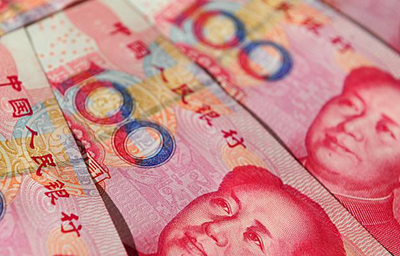
 SHANGHAI: China's yuan strengthened for a third straight session on Thursday as corporate dollar sales dominated amid signs that the central bank was staying on the sidelines, allowing the Chinese currency to recover from its recent weakness.
Dollar purchases by state banks -- a sign of intervention by the People's Bank of China (PBOC) designed to weaken the yuan -- appeared to subside this week, freeing the currency to reverse a large chunk of its losses since mid-January, traders said.
"The PBOC may feel that it has reached its goal to warn currency speculators by engineering the latest round of yuan depreciation," said a dealer at a European bank in Shanghai.
"The market believes the yuan may stabilise in the near term, possibly staging some decent rebounds and returning to a lingering long-term trend for the currency to appreciate."
Spot yuan stood at 6.1159 per dollar at midday, or 0.20 percent stronger than Wednesday's close after the PBOC fixed its official midpoint marginally higher at 6.1249 from Wednesday's 6.1257, possibly another sign that the central bank would be willing to let the yuan stabilise for now.
In the longer term, the world's second-largest economy still faces heavy capital inflows under both the current account and capital accounts -- which means the yuan still has potential to appreciate gradually, traders said.
In a related development, the PBOC and Chinese commercial banks purchased 437.4 billion yuan ($85 billion) worth of foreign exchange on a net basis in January, according to a Reuters calculation based on PBOC data released on Wednesday.
That was up sharply from 272.9 billion they bought in December, indicating stepped up official intervention into the yuan/dollar trading, traders said.
The PBOC and state banks have consistently bought foreign currencies flowing into the country over the past decade or so to help the government to control the pace of yuan appreciation against the dollar.
The PBOC also surprised global markets this year when it engineered a sharp decline in the yuan. Last week, the yuan suffered its biggest-ever weekly decline of around 0.9 percent, capping off its largest monthly loss -- 1.4 percent -- in February.
While there is various speculation of the purposes of the PBOC's latest move, some academics have criticised its intervention in trading, calling for freer convertibility.
"The essential method to curb hot money inflows and maintain financial stability is for the central bank to stop intervening into the foreign exchange market and let the yuan appreciate to proper levels once and for all," Yu Yongding, an influential researcher at the Chinese Academy of Social Sciences, said.


























Comments
Comments are closed for this article.