


 NEW YORK: US benchmark Treasuries yields rose above 3 percent to their highest level in more than two years on Friday, nearly assuring 2013 becomes one of the bond market's worst years in decades.
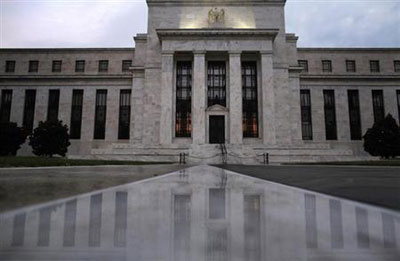
Traders further pared their bond holdings in anticipation of a further increase in yields in 2014, when the Federal Reserve will buy fewer bonds, after Fed policy-makers expressed some confidence the economy can grow with less monetary stimulus.
The key challenge facing investors in coming months is preparing for how quickly bond yields might rise, analysts say.
"The 10-year yield has been normalizing as the data have been coming in stronger," said Quincy Krosby, market strategist with Prudential Financial in Newark, New Jersey, which has $1 trillion in assets under management.
Barring a massive rally before year-end, the Treasuries market should book one of its worst years on record.
The Treasuries market has fallen 2.75 percent through Thursday, on track for its third steepest annual loss going back to 1973, according to an index compiled by Barclays.
Five years earlier, the Treasuries market lost 3.57 percent. In 1994, it fell 3.38 percent, the Barclays data showed.
However, analysts downplayed the 10-year yield's breach of the 3 percent threshold for the second time this year due to the light, post-Christmas trading volume.
"People are not going to set up new positions right now based on this number," said Lou Brien, market strategist at DRW Trading in Chicago.
The 10-year Treasury yield is a benchmark for mortgage rates and other long-term loan costs, as well as investment returns.
A steady, moderate increase in yields to, say, 3.5 percent should not harm the housing recovery or the Wall Street equities that set record highs in recent days, analysts said.
Big swings in yields toward 4 percent or 2 percent, however, could spook investors, causing them to pull money from stocks and other risky assets.
"As long as it happens slowly, it's not threatening for other markets. What markets don't want is a sharp move in either direction," Krosby said.
The rise in 10-year Treasuries yields has been steep, jumping 1.4 percentage points since May, when Fed Chairman Ben Bernanke told a congressional panel the central bank might consider scaling back its third round of quantitative easing, which has blown up its balance sheet by over $1 trillion.
Last week, the US central bank said it will reduce its monthly purchases of Treasuries and mortgage-backed securities by $10 billion to $75 billion in January, amid evidence of an improving economy.
At the same time, the Fed signaled its commitment to hold short-term interest rates near zero because unemployment has remained higher than policy-makers like and inflation has been stuck below their 2 percent target.
"The economic data have been better-than-expected, while at the same time the Fed is promising to be easier for longer. Then there's more chance of inflation later, which is driving the 10-year yield higher," said Brien.
Domestic inflation has remained low because wages have not been rising much.
While there has been a pickup in monthly job creation, much of the accelerated hiring has been in low-paying services sectors, analysts said.
There was no major economic release on Friday and the Fed will not resume buying Treasuries until later next week.
On the open market, the 10-year Treasury note last traded down 4/32 in price to yield 3.007 percent, after earlier rising as high as 3.02 percent, the highest intraday level since July 2011, according to Reuters data.
The yield spread between two-year and 10-year Treasuries grew to 2.61 percent, its widest since July 2011, up from 2.58 percent on Thursday and 2.51 percent a week earlier.






















Comments
Comments are closed for this article.