


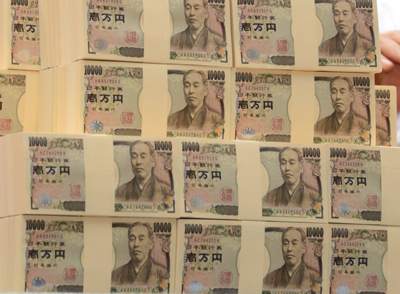
 TOKYOL: The yen weakened in Asia Monday following upbeat Japanese economic growth data and Tokyo's successful bid to host the 2020 Olympics, as well as weaker-than-expected US jobs figures.
The Japanese capital's Olympics win was seen as boosting support for a government bid to reinvigorate the Japanese economy with a stimulus blitz that has sharply weakened the yen since the start of the year.
In afternoon Tokyo trade, the dollar bought 99.62 yen against 99.11 yen Friday afternoon in New York where the greenback slid after the US government reported that the economy had added a worse-than-expected 169,000 jobs in August.
The dollar had briefly topped 100 yen earlier Monday but eased as Japanese exporters bought the yen to lock in the higher rate, dealers said.
The euro climbed to 131.24 yen from 130.62 yen in New York while fetching $1.3169 against $1.3180.
Japanese Prime Minister Shinzo Abe's policy prescription of big government spending and aggressive central bank easing to stoke the economy has helped shave about one-quarter off the yen's value against the dollar since the start of the year, giving a boost to exporters.
Dealers said a wave of popular support for Abe would likely see him press on with his economy-boosting scheme that will now see big infrastructure spending in the lead up to the Games.
"The yen is cheaper this morning because the successful bid to host the Olympics means market players think that Abenomics... will be successful," said Marito Ueda, senior dealer at FX Prime Corp.
Also Monday, Japan said second-quarter growth came in at 0.9 percent from the previous three months, better than an initial estimate of 0.6 percent.
National Australia Bank said the poor US jobs data "has come perilously close to stopping out our view" that the Fed will begin tapering its stimulus programme following a September 17-18 policy meeting.
"With no top-tier economic data due for release between now and then, we put the odds of a taper being announced later this month at no higher than 60 percent," it said in a note.
The Indian rupee jumped after Japan and India agreed Friday to more than triple their currency swap arrangement to $50 billion from $15 billion as Tokyo likely tries to assist India's stepped-up efforts to defend its weak currency.
The greenback was down to 65.24 rupees Monday afternoon from 66.12 rupees Friday afternoon before the revised currency deal was announced.
The dollar was mostly lower against other Asia-Pacific currencies.
It eased to 1,088 South Korean won from 1,094 won, to 44.38 Philippine pesos from 44.51 pesos, to Sg$1.2751 from Sg$1.2800 and to 32.29 Thai baht from 32.43 baht.
The dollar was flat at Tw$29.75 while it rose to 11,585 Indonesian rupiah from 11,110 rupiah.
The Australian dollar rose to 91.92 US cents from 91.33 cents after international credit agencies reaffirmed Australia's AAA credit rating following a conservative election win at the weekend.
The Chinese yuan edged down to 16.27 from 16.31 yen.


























Comments
Comments are closed for this article.