


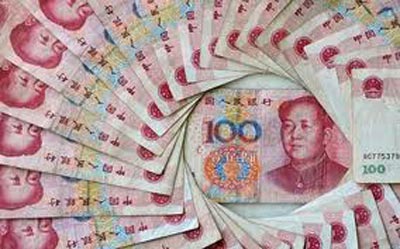
 SHANGHAI: The yuan closed at another record high against the dollar for the third straight day on Tuesday after the central bank set an unusually strong midpoint, but traders in the offshore market are signalling they think the currency is set to peak.
Traders in the domestic currency market initially attributed the central bank's string of aggressive midpoint settings to a visit by US Secretary of State John Kerry, but Kerry has since left China and yet the People's Bank of China continues to signal permission for the spot yuan to scale fresh heights.
Ordinarily the central bank sets the midpoint inversely to overnight moves in the dollar index to keep the rate stable, but the midpoint rose on Tuesday even though the dollar index also climbed overnight.
The move also flies in the face of predictions that Beijing would devalue the yuan alongside the Japanese yen after the Japanese government embarked on an economic stimulus programme that saw the yen lose nearly a quarter of its value against the dollar in the past six months.
Some traders theorized that the strong midpoint settings are intended as a gesture at recent pessimistic moves by foreign ratings agencies questioning China's management of its local debt.
However, Robert Minikin, forex strategist at Standard Chartered in Hong Kong, said the strong midpoint setting was to be expected given moves in the Japanese yen market against the dollar, which saw the yen strengthen in overnight trade before staging another correction during day trade on Tuesday.
Minikin did allow for political factors in the US continuing to exercise influence.
"We've got the G20 meeting next week and also we have the release of the semi-annual currency report from the US Treasury. The combination of these few things going on makes it a bit more attractive to move the dollar-CNY fix lower (stronger) at this point."
Minikin and other traders believe the market will begin to weaken in the near future.
China has seen a dramatic resurgence of speculative hot money inflows from overseas markets in recent months, which has complicated its monetary policy and made China's exports more expensive.
A trader in Shanghai told Reuters that corporates were still eagerly unloading foreign exchange on Tuesday, even in the face of mixed economic data that showed China's GDP grew more slowly than expected in the first quarter.


























Comments
Comments are closed for this article.