


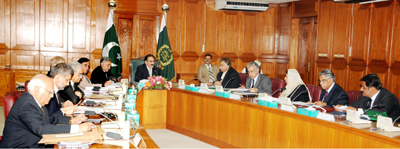
 ISLAMABAD: Chief Justice of Pakistan Iftikhar Muhammad Chaudhry on Saturday said that the military interventions in the political process, had weakened democratic institutions in the past.
Addressing faculty members of the Command and Staff College Quetta here, he said that such interventions impacted adversely on the constitutional and legal development in the country.
"Our democratic elected governments never truly consolidated democratic institutions. Neither, they were able to enforce good governance, economic progress or the culture of rule of law in the country. The primacy of un-elected institutions over representative organs left Parliament weak and subservient to the executive," he added.
He observed that parliamentary subordination to a powerful executive, had its roots in the weak political framework in early years of Pakistan.
"We did not have popularly or directly-elected legislature between 1947 to 1970. This also retarded the political development in the State," he added.
The Chief Justice referring to role of state institutions said that legislature, executive and judiciary, were the creation of Constitution itself, which was the supreme law of the land, therefore, it was incumbent upon them to work for the protection of this sacred document.
"Moreover, the Constitution itself manifestly provides that all the executive and judicial authorities shall act in aid of the Supreme Court. Those nations progress and prosper smoothly which value, follow and safeguard the Constitutional norms," he pointed out.
He said the history of Pakistan reflected recurring conflict between the under-developed political system and well organized army.
"When there are political crises, we have witnessed military intervention followed by military rule. Thus, there emerged a
vicious circle of brief political dispensation followed by prolonged military rule. This state of affairs brought many setbacks and hampered the process of evolution of constitutionalism and democratic system of governance," he added.
Lauding Pakistan Army, he said it was heartening to note that the morale and spirit of the Pakistani Armed Forces was high and its every officer and Jawan was working as a committed defender of national frontiers.
"In doing so, you have the backing of the entire nation," he added.
Alluding to Army role, the CJ said every member of the Armed Forces, according to his oath, was bound to bear true faith and allegiance to Pakistan and uphold the Constitution which embodied the will of the people.
"Furthermore, he will not engage himself in any political activities whatsoever, and will honestly and faithfully serve Pakistan," he added.
He said in the constitutional history of Pakistan, it was also for the first time that in Constitution of 1973, the oath of the members of the Armed Forces had been incorporated. So a conscious effort was made by its framers to clearly delineate role for the Armed Forces, responsible to safeguard the Constitution as well from any adventurism.
Further elaborating his viewpoint he said "The Supreme Court in its various judgments had held that the solider and the citizen stood alike under the law. Both must obey the command of Constitution and show obedience to its mandate."
A government elected by the Constitution could only perform its functions and ensure observance of the provisions of the Constitution by making the civil power superior to and not subordinate to the Armed Forces during peace and war, he added.
Stressing the rule of law, he said that it was the basic trait of a democratic government and an egalitarian society was not possible unless and until every segment and institution of society made a deliberate effort to not only imbibe it but practice it as well.
"Welfare of the people must be the supreme consideration of all institutions and all functionaries of the State. But in achieving this grand objective, we must make consistent efforts, by remaining in our allotted sphere to realize the same," he added.
Further appreciating role of the Armed Forces, he said in the times of natural calamities, it played commendable role in the rescue and relief operations whether it was the devastating earthquake in Kashmir, Khyber Pakhtunkhawa and Islamabad in the year 2005 or the recent flood catastrophe.
"If the Armed Forces would have not responded promptly and effectively to these catastrophes, the destruction in term of precious life and property, would have been more severe and painful," he added.
The CJ said similarly, our Armed Forces successfully maintained the writ of the Government in different parts of the country sacrificing precious lives of many Officers and Jawans to restore normalcy and maintain peace in the country.
He further said as civilized member of the community of the nations, it was their obligation to fully contribute towards international peace and progress and happiness of the humanity.
The Armed Forces of Pakistan, under the flag of United Nation, frequently undertake peace-keeping operations. They had played decisive role in numerous peacekeeping operations around the world, including Cambodia, Somalia, Bosnia, East Timor and Sierra Leone, he added.
The Pakistan Army had been regarded over the years as highly disciplined and trained force.
"I am confident that keeping in view the role of the Defence Forces in the past against external aggression, you will live up to your traditions, whenever you are called upon to defend your country," he said.




















Comments
Comments are closed for this article.