


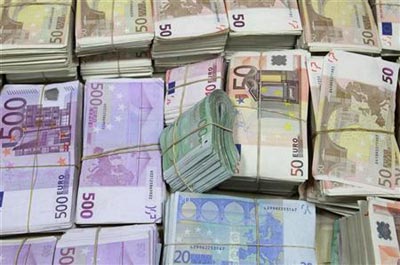
 LONDON: Cyprus' deposit grab sets a bad precedent. Money had to be found to prevent its financial system collapsing.
But imposing a 6.75 percent tax on insured deposits is a type of legalised robbery.
Cyprus should instead impose a bigger tax on uninsured deposits and not touch small savers.
Confiscating savers' money will knock confidence in the banks.
Trust in the government will also take a hit, since Nicosia had theoretically guaranteed all deposits up to 100,000 euros.
Small savers should be encouraged not penalised.
They are the quiet heroes of the financial system, who squirrel away their savings, not those who drag it down by engaging in borrowing binges.
Nicosia has not technically broken its promise to guarantee small deposits.
That's because it is not the banks which are failing to repay savers something which would have triggered the insurance scheme.
Instead, it is the government itself which is grabbing a slice of deposits.
The pill is also being sugared by giving savers shares in the banks as compensation.
That said, the mechanism is still an effective breach of promise.
There's no denying that Cyprus needed a solution.
The small Mediterranean island was on the brink.
Its banking system which had grown to eight times GDP on the back of inflows of Russian money and aggressive expansion in Greece was technically bust.
Its exposure to the Greek economy, Greek government debt and Cyprus' own burst property bubble had seen to that.
Nicosia's euro zone partners made clear there was no time to waste.
They had chosen the date of their finance ministers' meeting on Friday night, knowing that Cyprus already had a scheduled bank holiday this Monday.
The country's president says the European Central Bank was threatening to cut off liquidity on Tuesday if there was no deal.
The banking system would have collapsed.
In total, Cyprus requires 17 billion euros almost 100 percent of GDP to rescue its banks and deal with the government's own bills.
If Nicosia had borrowed all that cash on top of its existing debt, it would have been carrying an unsustainable burden.
It would have only been a matter of time before the debt needed restructuring.
Cyprus' euro zone partners and the International Monetary Fund rightly decided not to lend it so much money, limiting the bailout to 10 billion euros.
This means Nicosia should end up with debt equal to a manageable 100 percent of GDP in 2020.
The problem was where to find the extra 7 billion euros.
Given that Germany and other northern European countries weren't prepared to give a handout, there were two options: haircut the government's own bondholders or hit bank creditors.
The option of haircutting government debt as Greece did last year was rejected.
Many bonds are held by Cypriot banks, so a haircut would just have increased the size of the hole in their balance sheets, meaning they would have needed an even bigger bailout.
The Cypriot government's credit would have been destroyed for little benefit.
So, by default, the banks' creditors had to be tapped. Ideally, bank bondholders would have taken the strain.
But Cypriot banks have hardly any bonds. So there wasn't much money that could be grabbed there.
This, incidentally, rams home the importance of requiring all banks to have fat capital cushions consisting either of equity or bonds that can be bailed in during a crisis.
The sooner international regulators come up with a minimum standard for so-called "bail-in" debt, the better.
Given that Cypriot banks didn't have such a cushion, the remaining option was to hit depositors for 5.8 billion euros.
There was even some rough justice in the policy. After all, up to half of the country's 68 billion euros of deposits is held by Russians and Ukrainians and some of this money is thought to be black money laundered through Cyprus.




















Comments
Comments are closed for this article.