


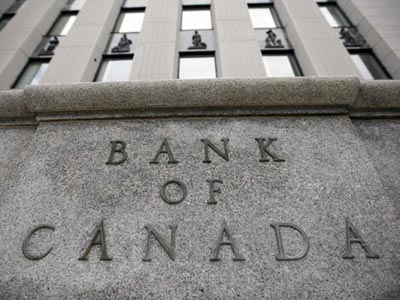
 OTTAWA: Canada's central bank maintained its key lending rate at one percent Tuesday, noting inflation was largely subdued despite stronger than anticipated economic growth.
The Bank of Canada said aggregate demand is "rebalancing" toward business investment and net exports, and away from government and household expenditures.
Canadian business investment will continue to rise rapidly and consumer spending will evolve in line with personal disposable income, it forecast.
In contrast, growth in exports is expected to be further restrained by ongoing competitiveness challenges reinforced by the recent strength of the Canadian dollar.
"The persistent strength of the Canadian dollar could create even greater headwinds for the Canadian economy, putting additional downward pressure on inflation through weaker-than-expected net exports and larger declines in import prices," the central bank said.
Overall, the Canadian economy is now expected to grow by 2.9 percent in 2011 and 2.6 percent in 2012, followed by 2.1 percent in 2013.
The global economic recovery, meanwhile, is becoming "more firmly entrenched" and would likely continue at a steady pace, the bank said.
Growth in the United States Canada's largest trading partner was solidifying but slow due to high government and household debt levels.
Europe has posted gains despite its sovereign debt and banking woes.
And the disasters that struck Japan in March will "severely" curtail its economic growth in the first half of this year, creating short-term supply chain disruptions in advanced economies, Canada's central bank predicted.
Robust demand in emerging market economies and supply shocks arising from recent geopolitical events boosted commodity prices. This contributed to the emergence of "broader global inflationary pressures."
But global financial conditions remain very stimulative and investors have become noticeably less risk averse, the bank noted.




















Comments
Comments are closed for this article.