


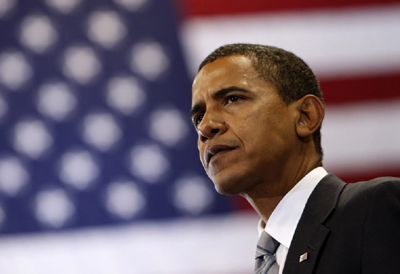
 WASHINGTON: A jump in gasoline prices is threatening to smother the flickering flames of the US economic recovery and with them President Barack Obama's hopes of retaining the White House.
Groggy but still standing after a four-year slog through recession, the US economy has -- just about -- weathered shocks from Japan's earthquake and tsunami, the Arab Spring and Europe's ongoing debt crisis.
Now, as unemployment finally starts to ease and growth picks up, rising oil prices could land another blow to the gut of the world's largest economy.
In the last year, tensions in Iran, Syria, Libya, Nigeria and South Sudan, refinery squeezes and hardening global demand have conspired to push crude and gasoline prices higher.
For Americans that has meant a 12.5 percent rise in prices at the pump -- from an average of $3.17 a gallon a year ago to $3.57 today -- defacing many a household balance sheet.
Rising energy prices are "one of the predominant risks to the economy this year," according to Deutsche Bank's chief US economist Joseph LaVorgna.
LaVorgna and his team estimate that for every one cent increase in gasoline prices, household energy costs increase by around $1.4 billion.
That cash for the most part goes abroad, instead of washing through the domestic economy.
There are signs that rising prices are starting to shake consumer confidence. According to Gallup and other pollsters, economic confidence has started to retreat after a series of encouraging gains.
Oil prices are actually expected to fall in the next few months as the Northern Hemisphere enters the lull between high-demand periods of winter and summer, but the relief will likely only be temporary.
According to the American Automobile Association, gasoline prices could rise as high as $4.25 by the end of May, well beyond the symbolic $4.00 point that many Americans consider too high.
Ironically, the strengthening economy may be to blame.
"Building economic momentum, albeit from a weak base, has the potential to pull oil prices higher for the next 12 to 24 months," JPMorgan's analysts told clients on Tuesday.
If rising oil prices spell bad economic news for the country, then they are also bad news for Obama politically.
Presidential approval ratings sometimes have a strong link with rising gasoline prices, as was the case with Obama's predecessor George W. Bush. On other occasions the link has been less pronounced.
The White House appears concerned. On Thursday Obama is expected to return to the subject of energy policy at a speech in Miami, Florida.
At the very least, rising prices have given Obama's political foes ammunition even as the economy recovers, while deadening the impact of a hard-fought $40 a month tax cut for Americans.
Republican presidential hopefuls Mitt Romney, Rick Santorum and Newt Gingrich have already sought to pin the blame for higher oil prices on the Democratic incumbent.
They point to Obama's opposition to offshore drilling and a pipeline from Canada, as well as his support for ending oil company tax breaks, as contributing to higher gas prices.
Gingrich has even promised to bring gasoline down to $2.50 a gallon.
All of the Republican candidates hope their pro-energy stance will open the wallets of big oil as they continue their costly presidential campaigns.
The White House has punched back, with spokesman Jay Carney on Tuesday cautioning that "there are no magic solutions to rising oil prices."
The White House also accuses Republicans of political opportunism.
"The president is very aware... of the impact that the global price of oil has on families, and this is not something that this administration discovered or rediscovers every spring as some politicians do," Carney said.
Obama does have some options to ease prices, according to Ed Yardeni, an energy strategist with Yardeni Research.
"The Obama administration will undoubtedly tap into the SPR (Strategic Petroleum Reserve) soon if the price of gasoline remains at current levels or moves higher," he predicted.
Last June, Obama ordered the release of 30 million barrels from the US reserve as the war in Libya raged, helping to ease gasoline prices from a high of around $4.00 a gallon.
The White House may soon have to respond to further foreign disruptions as tensions escalate over Iran's controversial nuclear program.
Neither the United States nor most other Western nations source a large portion of their oil from Iran, but a confrontation with Tehran could spook the market and push prices higher.
In 1979, then-president Jimmy Carter's reelection campaign struggled amid high gasoline prices, thanks in large part to turmoil following Iran's revolution, and in the end he was denied a second term.


















Comments
Comments are closed for this article.