


 BRUSSELS: Eurozone finance ministers will seek Monday to finalise a second Greek bailout in a deal which they hope will also quell suggestions that Athens could be pushed out of the currency area.
The deal to write off 100 billion euros ($130 billion) of debt and provide a loan of 130 billion euros is contingent on painful new spending cuts that Athens must make despite violent protests.
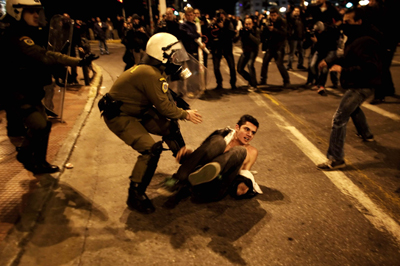
Early Sunday, hundreds of people joined a protest in central Athens against the austerity measures that include a 22 percent reduction in the minimum wage.
For the Greek caretaker government led by Lucas Papademos, time is of the essence because without the bailout Greece will be unable to meet a bond repayment of 14.5 billion euros on March 20.
After several false starts during weeks of what officials said was "deliberate pressure" to get the ruling class in Athens to change its economic mindset, a strong political and financial signal is now anticipated from the Eurogroup meeting.
EU partners see Greece as the victim of chronic financial mismanagement by dynastic political forces -- what Italian Prime Minister Mario Monti last week called a "perfect catalogue" of errors.
Amid the deep scepticism, the new bailout has been likened to the aid equivalent of a hospital drip, with a small army of EU officials heading to Athens to make sure Greece delivers on its austerity pledges.
The Italian government -- until recently, most at risk of financial-market contagion given a massive debt burden there -- said Friday that German Chancellor Angela Merkel, Monti and Greek counterpart Lucas Papademos were "confident that a deal can be reached on Greece at the Eurogroup," after telephone talks.
But while Greek party leaders seeking power in a general election set for April have committed separately to carrying out radical reforms, hardliners have floated a willingness to cut the country adrift of the euro.
Arguments about how far the eurozone can dictate day-to-day decision-making in sovereign Greece, which has already benefitted from a 110 billion euro rescue approved in May 2010 by the EU and the IMF, still have a way to run.
Work on the figures will keep officials busy right up until the 3:30 pm (1430 GMT) start of the Eurogroup meeting Monday, with 11th-hour discussions to iron out details on Sunday.
There are still issues to resolve before a deal can be announced that will free the eurozone to park the Greek problem to one side, and return the focus to building a financial firewall for the currency as a whole at a March 2 euro summit.
These involve the functioning of an "escrow" account, which would ring-fence monies due to be repaid to eurozone governmental partners, while leaving just enough "incentive," as one source said, to encourage Greek taxation reform and privatisations.
There is also a 5.5 billion euro hole in the sums, as one senior official revealed to AFP last week.
Ideas include lowering the interest on past eurozone loans to Greece and involving national central banks -- and by extension the European Central Bank itself -- in an exchange of old Greek bonds that had already lost market value for new IOUs.
Germany and The Netherlands still need to get the second bailout past sceptical parliaments, though.

















Comments
Comments are closed for this article.