

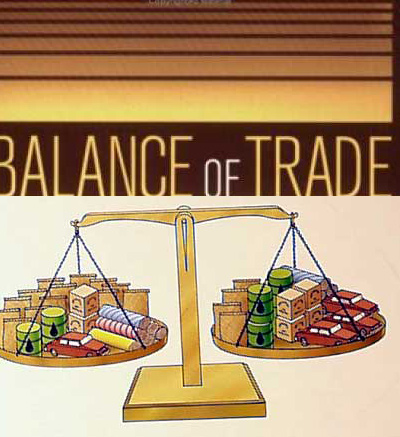
 The news on the external sector continues to be highly disturbing. According to the latest data released by the Pakistan Bureau of Statistics (PBS), Pakistan's trade deficit touched a new record of $13.17 billion during July-January, 2012, showing a tremendous increase of 39.77 percent when compared with $9.42 billion in the same period last year. The huge gap in the merchandise account was attributable to a sharp rise in imports in the face of a negligible increase in exports. While Pakistan's exports totalled $13.15 billion, showing a marginal increase of one quarter of a percentage point, imports ballooned by 17 percent to reach $26.33 billion. The current level of exports at less than half of imports is definitely a worrisome development and should serve to sound the alarm in Islamabad. A related issue of serious concern is a substantial slowdown in exports in the recent months. Exports, for instance, slumped to only $1.953 billion in January, 2012 from $2.307 billion a year ago, reflecting a sharp decline of 15.34 percent, whereas imports have continued to grow and were recorded at $3.65 billion in January, 2012 or higher by 6 percent as compared with $3.44 billion in the same period of last year. The situation with regard to inflow of foreign investment was more adverse than the trade deficit. During July-January of FY12, FDI declined to only $594 million compared with $1.002 billion in the same period of last year, registering a massive fall of 40.7 percent. Major fall in investment was registered in the telecommunication and oil and gas exploration sectors, whereas FDI flows to the power and financial sectors recorded a modest rise. While decline in FDI in telecommunication probably reflects saturation in this sector, investment in oil and gas sectors has been hampered by deteriorating law and order situation and, more specifically, by increasing incidents of attacks on gas pipelines and oilfields in Balochistan and KP. Portfolio investment has witnessed reverse flows during the year due largely to political uncertainty and certain other unfavourable developments in the economy. An outflow of $147 million was registered in portfolio investment during the first seven months of FY12 in sharp contrast to an inflow of $235 million in the corresponding period last year. As a result of deterioration in various components, the current account of the country has registered a massive deficit of dollar 2.63 billion during July-January, 2012, or almost up by 27 times, as compared to only dollar 96 million in the corresponding period of last year. A sharp increase in trade deficit can be attributed to a number of factors. Productivity within the economy is suffering a huge blow due to continued severe energy shortages, poor law and order situation, political uncertainty and falling investment and this has retarded the growth of exportable surpluses and the capacity of the country to earn more foreign exchange. A decline in unit prices of several exports, particularly those of cotton products, in the international market has also added to the woes of the policymakers in this area. Exports have also suffered in the wake of the global recession, especially in Europe and the United States, which are our major export markets. Obviously, a considerable depreciation in the value of the rupee against the US dollar in the past few months has not helped Pakistan's export products to penetrate in the international markets. On the other hand, the oil and food import bills are likely to swell in 2011-12 and there is increasing demand for raw materials for the manufacturing sector in anticipation of a further decline in the value of the rupee in the coming months. The government had projected exports at $25.62 billion, imports at $42.91 billion and trade deficit at $17.29 billion during FY12, however, the trend so far, especially in the last three months or so, indicates that the situation with regard to the merchandise account would be much worse than the initial targets. As for foreign investment, it is quite clear that the overall situation in the country is not at all conducive for foreign investors. They are dismantling their investments and looking for safe havens abroad. There is also a paucity of financial inflows from other sources. Besides, financial resources borrowed from the IMF under SBA have to be repaid in instalments. The only saving grace is a steady flow of home remittances but this cannot neutralise the adverse impact of the above factors, with the result that the country is almost certain to face a huge current account deficit in the coming period with all the ugly consequences. In its latest monetary policy statement, the State Bank had projected the C/A deficit to remain in the range of $3.5 billion to $5.5 billion or 1.5 percent to 2.4 percent of the GDP but the latest data indicates that the actual deficit may be nearer to the upper range or even exceed it. Seen objectively, the factors responsible for deterioration in the foreign sector accounts are not likely to disappear anytime soon or lose their intensity to cause problems for the economy of the country. It is also not difficult to visualise the severe negative implications of the continuity of such a trend in the form of dwindling foreign exchange reserves, erosion of the value of the rupee, flight of capital, higher debt servicing in rupee terms, further rise in domestic prices etc. In such a background, and in the absence of any sort of control on exogenous factors, the government must concentrate on improving the domestic policy environment to enhance exports and restrain imports to balance the current account. For instance, fiscal consolidation has to be ensured for macroeconomic stability, the law and order situation has to be improved, policy consistency has to be maintained and energy supplies have to be enhanced substantially to attract investors to increase industrial production and exports. As there are no easy alternatives, all the suggested areas of improvement would need consistent effort and a lot of determination to turn the tide in the country's favour. Hopefully, the government, currently bogged down mostly in political problems, would find enough time to give due attention to the economic imperatives of the country. Copyright Business Recorder, 2012


















Comments
Comments are closed for this article.