

BoJ holds rates, expands growth-sector lending

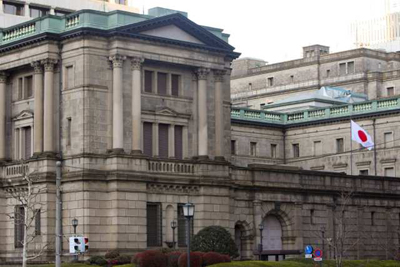 TOKYO: The Bank of Japan on Tuesday left its key rate unchanged at between zero and 0.1 percent and said it would expand a programme of lending to companies in growth areas to support the economy.
The BoJ's policy panel voted unanimously after a two-day meeting to keep rates unchanged while expanding last June's 3 trillion yen ($37.4 billion) lending facility to encourage banks to channel funds into sectors such as renewable energy and medicine.
The central bank will offer a new credit line of up to 500 billion yen under a new facility designed to make it easier for smaller firms to access cash from banks without using traditional real estate collateral.
Each bank can borrow up to 50 billion yen at 0.1 percent annual interest for up to four years.
"With a view to further encourage financial institutions' efforts, the bank deems it appropriate to focus on supporting their provision of equity-like funds and loans without conventional collateral or guarantees," the central bank said in a statement.
The BoJ also slightly upgraded its assessment of the economy, which "continues to face downward pressure, mainly on the production side due to the effects of the earthquake disaster but is showing some signs of picking up."
The BoJ said the Japanese economy was likely to return to " a moderate recovery path" in the second half of the year.
The world's third-largest economy plunged back into recession in January-March, contracting on the impact of the nation's biggest recorded earthquake, a tsunami and a nuclear emergency that sent Japan into its worst post-war crisis.
In the aftermath of the earthquake, the BoJ injected a record amount of cash into the banking system and doubled an asset purchase fund to 10 trillion yen, a key policy tool it kept unchanged Tuesday.
It also set up a separate lending scheme for banks in quake-hit areas to ensure financial institutions in disaster-hit areas can meet demand for post-quake reconstruction funds.
The 9.0-magnitude earthquake and a tsunami on March 11 destroyed entire towns and left more than 23,000 dead or missing while crippling the Fukushima Daiichi nuclear plant, leading to radiation leaks and power shortages.
Many of Japan's biggest firms were forced to suspend plants and slow output due to the quake's impact on supply chains and power supply, which heavily disrupted production.
Sentiment among large Japanese companies tumbled to its lowest in two years during April-June, a government survey showed Tuesday, after the impact of the March 11 disasters.
The index measuring the mood among big companies stood at minus 22.0 in the second quarter compared with minus 1.1 in the previous three months, a joint survey by the Finance Ministry and the Cabinet Office showed.
It was the lowest reading since minus 22.4 in April-June 2009, when Japan's economy was struggling amid the global financial crisis.
Copyright AFP (Agence France-Presse), 2011






















Comments
Comments are closed for this article.