


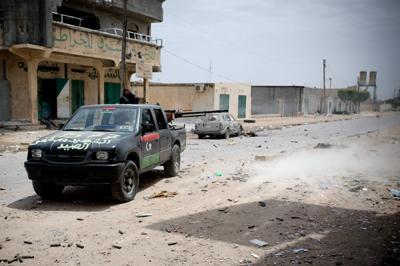
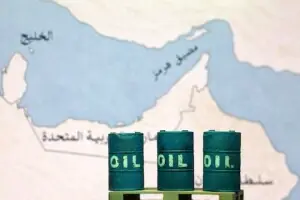
 AJDABIYA: Libyan rebels pounded in besieged Misrata and on the run Wednesday in eastern oil towns, accused NATO of failing to protect civilians, as the regime offered talks if the insurgents disarm. The rebel accusation came as they sustained their first significant loss of territory to Moamer Qadhafi's forces in almost a week, after they were sent fleeing from the edge of the oil town of Brega in a major assault. Rebel spirits however were boosted when a one-million-barrel super tanker docked in the port of Tobruk, ready to load their first oil export shipment, potentially worth more than 100 million dollars (70.5 million euros). The top commander of rebel forces, Abdelfatah Yunis, accused NATO-led aircraft of doing nothing while loyalist forces kept up their 40-day long artillery bombardment of civilians in the western city of Misrata. NATO "is letting the people of Misrata die every day," Yunis told reporters in the rebel stronghold of Benghazi late on Tuesday.
"If NATO waits one more week, there will be nothing left in Misrata," he added.
"If NATO wanted to break the blockade of the city, they would have done it several days ago. Every day, civilians, elderly people and children, are dying in Misrata. Libya's third largest city located 214 kilometres (132 miles) east of Tripoli, since the uprising began on February 15. The figure is likely to have risen in recent days. A Turkish aid ship at the weekend brought out scores of wounded from the city, who told harrowing tales of the bombardment of residential areas by loyalist artillery. NATO's chief of allied operations, Brigadier General Mark van Uhm, said the alliance was doing all it could to protect civilians in the city.
"Misrata is a number one priority because of the situation on the ground over there," the NATO chief of allied operations said.
"We have confirmation that in Misrata tanks are being dispersed, being hidden, (and) humans being used as shields in order to prevent NATO sorties to identify targets," he said. Van Uhm said that the international air operation, under NATO command since late last week, had had a major impact.
"We have taken out 30 percent of military capacity of pro-Qadhafi forces," said Brigadier General Mark van Uhm, citing an assessment by the Libya operation's commander, Lieutenant General Charles Bouchard. Qadhafi's forces pushed back rebels from the oil refinery town of Brega on the central Mediterranean coast, despite a NATO air strike on loyalists who launched an intensive artillery barrage that sent their foes fleeing towards Ajdabiya, a transport hub about 80 kilometres (50 miles) to the east. Thursday morning, rebels were preventing civilians and journalists from leaving Ajdabiya and said both sides were shelling each other at the front, which they said was about 40 kilometres towards Brega. Khaled Saleh, 32, an ex-soldier guarding the checkpoint at Ajdabiya, complained about lack of NATO airstrikes on Qadhafi's forces.
"It was much better when it was America and France (in charge of enforcing the no-fly zone). They bombed Qadhafi's forces as you can see here," he said, pointing to burnt out husks of military vehicles nearby.
"NATO just flies around until they use up all their fuel and then they go home." Rebel leaders played down the loss of territory, saying it was unlikely to be the last reverse they suffered before Qadhafi's regime was overthrown.
"There is no revolution without setbacks," Mustafa Gheriani, a spokesman for the rebels' Transitional National Council told AFP.
"But the people will win. Qadhafi cannot rule Libya with his machine, his militias and his mercenaries... We are committed to fighting this tyrant, and either we will drive him out or he will rule a country with no people in it." In Tripoli, deputy foreign minister Khaled Kaim told reporters that Qadhafi's regime will talk with the country's rebels about reforms if they lay down their arms.
"They must lay down their arms. Then they can join the political process," Kaim said, adding that the process could be guaranteed by African Union and UN observers "who will dispel any doubts." An AU committee comprising the leaders of Mauritania, Mali, Congo, South Africa and Uganda would visit Libya next week to help find a solution to the Libya crisis. A UN Human Rights Council mission will also visit Libya from April 15, said Kaim. Libyan government spokesman Mussa Ibrahim had said Monday that Qadhafi's regime was ready for negotiations on elections or a referendum but that the Libyan leader's resignation was not negotiable. The government meanwhile named deputy minister for European affairs Abdelati Obeidi as its new top diplomat to replace Kussa, the long time head of Libyan intelligence who was regarded as a key confidant of Qadhafi before he took refuge in Britain last week, a senior foreign ministry official told AFP. A former prime minister, Obeidi, has also served as foreign minister before. Qadhafi's son Seif al-Islam had earlier dismissed Kussa as a "sick and old" man who succumbed to the psychological pressures of war. A senior US diplomat arrived in Benghazi for talks with the rebels but the State Department said the move did not imply any recognition of their administration. The envoy, Chris Stevens, will focus talks on humanitarian assistance as well as the rebel leadership's "democratic aspirations, commitment to universal human rights," said a State Department spokesman in Washington. In The Hague, the prosecutor of the International Criminal Court said the killing of civilians in Libya followed a "pre-determined plan" that Qadhafi had prepared before the unrest.
"In January, after the revolts in Tunisia, they started to prepare to face problems in Libya, they organised themselves," Luis Moreno-Ocampo told AFP. Moreno-Ocampo announced on March 3 that the ICC was investigating Qadhafi, three of his sons and other members of his regime for crimes against humanity.









Comments
Comments are closed for this article.