



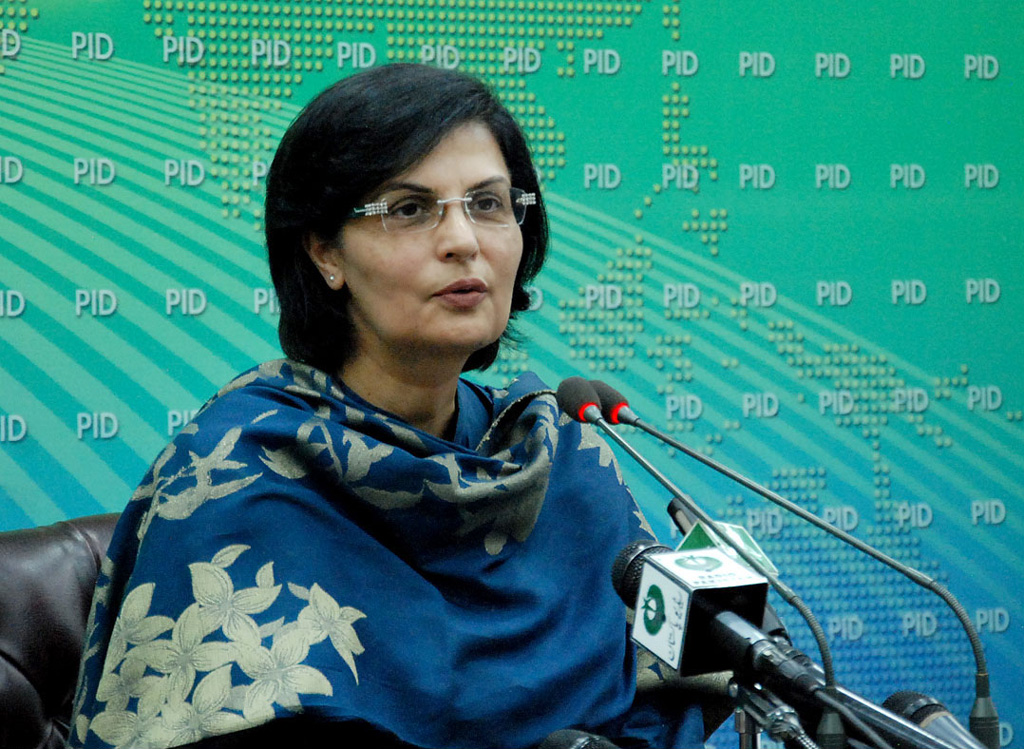
 ISLAMABAD: Dr. Sania Nishtar, Special Assistant to the Prime Minister on Social Protection and Poverty Alleviation Wednesday said that Benazir Income Support Programme (BISP) implementation research platform would be established soon.
She was chairing a research meeting here where findings of research conducted by Oxford Policy Management Group (OPM) were presented, said a press release.
Department for International Development (DFID) has contracted Oxford Policy Management (OPM) to execute the third-party beneficiary feedback, operational review and monitoring assignment for BISP cash transfer programs.
This assignment is spread over a period of two years and findings were presented at the ‘Stakeholder Workshop on Learning from Beneficiary Feedback and Process Review of BISP’.
Speaking on the occasion, Dr. Sani Nishtar said that BISP was undergoing a multi-pronged process of reform and that process was heavily being guided by evidence.
She said that the reforms embodied creation of a new payment system, a new national census level Socio-Economic Survey, a new communications strategy and new program windows, especially configuring BISP’s operations around Kifalat and Tahafuz. The reforms also embodied deeply rooted changes at the governance, risk assurance and management and operational levels and that at every stage, they were drawing on evidence to make changes.
She further added that “in addition to findings of formal process evaluations, she was relying on audit reports—internal and external—third party reports, reports from management information systems, complaint management systems and monitoring and evaluation insights to garner the evidence needed for the changes being introduced”. “Integrity of operations was the foremost priority”, she further added.
Dr. Sania Nishtar said that BISP’s Kifalat was a very important social safety programme of the government of Pakistan; however, it was part of the much bigger "Ehsaas" initiative.
"Ehsaas" is the flagship programme of the prime minister being implemented with 29 federal ministries, divisions, agencies and public sector departments for structurally reforming the social protection and poverty alleviation in the country.
BISP is responsible for execution of 7 out of the 115 policy actions of "Ehsaas".
BISP, however is the largest executing agency of newly established Poverty Alleviation and Social Safety Division (PASSD). Under the umbrella of "Ehsaas", BISP incorporates Tahafuz and Kifalat initiatives.
Kifalat will ensure financial and digital inclusion of around 6 million women through the one woman one bank account and mobile wallet policy.
These women will also be linked to government’s digital resources as a public good to create opportunities for them to graduate out of poverty.
Similarly, Tahafuz refers to the launch of the shock-oriented precision safety net for the vulnerable to protect them against shocks.
This will mainly involve one-time financial assistance to protect against catastrophic events.
Talking about the findings of the process review assignment, Dr. Nishtar reiterated that implementation research and beneficiary feedback was very important to make improvements in the running programs as it provided concrete evidence and direction to make robust changes in the systems and address the loopholes, as and when they arise.
Ali Raza Bhutta, Secretary BISP, Seema Ilahi Baloch, Team Leader DFID funded project, Oxford Policy Management, Patricia Seex, Head of Economic Growth Unit DFID Pakistan and Gul Najam Jami from The World Bank, Pakistan were also present at the occasion.
The implementation research findings are expected to improve programme performance, assess whether programme implementation is in accordance with BISP’s guidelines and inform DFID on verification of selected disbursement-linked indicators.





















Comments
Comments are closed for this article.