



The IMF country report on Pakistan is here. So now we know where we are headed, or have promised to be headed, for the Letter of Intent to the IMF is perhaps the most comprehensive policy document to come out from any government source. Of repeated mentions is the energy sector amongst other things, and while the gas and power sector will take the headline – much of that is already in the public domain.
What we now know is that the FBR will be saved of issuing one petroleum tax rates SRO every month. Unless of course the international crude oil prices decide to nosedive from the current range or the rupee gives dollar a real good hiding. The chances of both events are as slim as they come. The government in its LoI to the IMF while laying out the promises has put the floor on both GST and Petroleum Levy on petroleum products at 17 percent and Rs15 per liter, respectively.
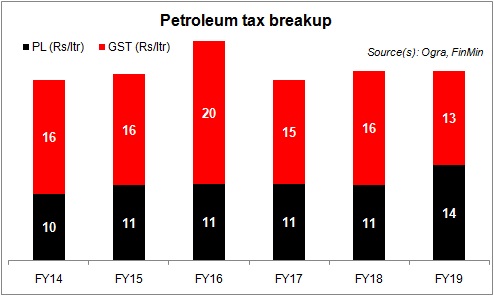
So what happens now? The Petroleum Levy (PL) has been jacked up of late in a bid to brush up revenues, particularly those that are not to be shared with the provinces. That said, the full year FY19 revenue on account of PL has averaged Rs14/liter, amounting to nearly Rs200 billion – up from the trailing 5-year average of Rs11/liter. As per the understanding with the IMF, the PL per liter will have a flooring of Rs15/liter – which is the minimum rate.
The PL revenues in the budget FY20 have been budgeted at Rs260 billion, which translates into Rs18/liter – an increase of 30 percent year-on-year on account of PL rate. This is assuming the petroleum product demand stays at FY19 levels, which is highly probable, given the slowdown in economic activities to continue for the next 12 months at least.
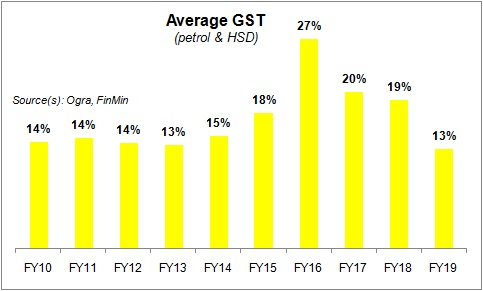
Then, there is the GST part of the equation, which will continue to be treated in percentage terms, instead of having it fixed in absolute terms, to let go of the unnecessary hassle, criticism and credit that happens month after month. The GST on petroleum product averaged 13 percent or Rs13.4/liter in FY19. Should things stay the same, petrol at 17 percent GST would be costlier by another Rs5/liter, assuming dollar at 160, and international crude oil at July 2019 average of $65/bbl.
The total taxes on petroleum products in FY19 were Rs27/liter, and barring FY16, Rs27/liter has been a norm. It now appears the taxes will be north of Rs32/liter in FY20 – with a potential to go higher. In a scenario where rupee has consistently shed value against the greenback, petrol prices could well end up being in the range of Rs125-130/liter, for much of FY20. The LoI to the IMF also suggests that “Sales tax measures are mostly focused…. enhancing the sales tax of petroleum products.” This, in part explains, why the IMF has projected the core inflation to average 13 percent for FY20. Brace yourselves for some “petrol bombs”





















Comments
Comments are closed for this article.