


Saudi Arabia has largely covered its hard currency funding needs for 2018 by completing this week's $11 billion international bond issue, the head of the kingdom's debt management office said. Riyadh has become one of the biggest emerging market debt issuers since it started borrowing internationally in 2016 to finance a state budget deficit caused by low oil prices.
This week it issued its fourth international bond in tranches of seven, 12 and 31 years, attracting massive investor orders of $52 billion. That followed last month's $16 billion syndicated loan refinancing, which expanded the original facility by $6 billion. Fahad al-Saif, speaking by telephone late on Wednesday, noted that together, the two exercises raised a net $17 billion - in the range of the $16 billion-$18 billion that Riyadh initially planned to borrow internationally this year.
As a result, Riyadh will focus on raising money domestically for the rest of this year, Saif said. It has said it wants about 65 percent of its debt to be domestic and 35 percent foreign, plus or minus 10 percent. "We still have the local portion to finance. As you're aware we are obliged to find the best place to fund our issuances, and I think the focus from now going forward is the local market development."
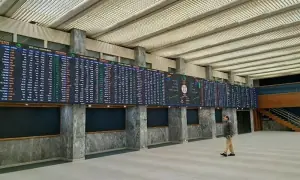
Saudi Arabia has borrowed 18 billion riyals ($4.8 billion)domestically so far this year with monthly issues of riyal-denominated Islamic bonds, and plans to raise about 60 to 70 billion riyals in total in 2018, subject to market conditions, Saif said. This month the Saudi stock exchange began listing domestic government bonds in a move that is expected to facilitate riyal issuance by encouraging secondary market trade.
But Saif said Riyadh would not neglect the international market because it was keen to ensure a stable yield curve. "We are very committed on being a regular issuer, a responsible borrower in this market." He added, "We are focused on liquidity, and when I say liquidity I very much mean balancing between supply and demand, and obtaining further investor diversity.
"We are very much focused on secondary market behaviour, on how exactly each point of the curve behaves, and we want our curve to become stable, reliable, and to become a benchmark for the region." While the kingdom has no immediate plan to make an international issue of Islamic bonds, it might do so in the second half of 2018 to maintain its presence in the sukuk area and provide supply to sharia-compliant investors.
The potential sukuk issue would be smaller than Saudi Arabia's previous international sukuk transaction, which was $9 billion, Saif said. Riyadh issued its latest international bond a few days before a planned global issue by Qatar, which would be Doha's first foreign bond sale since Saudi Arabia and allies cut diplomatic and transport links with Qatar last June, accusing it of backing terrorism, a charge which Doha denies.
Some bankers and fund managers told Reuters that by absorbing some demand in the market, the Saudi issue might complicate Qatar's funding plan, potentially forcing Doha to offer higher yields. Asked if Qatar was a consideration in the timing of the Saudi deal, Saif said it was determined by market conditions.
"We are a sophisticated debt management office. We looked into market volatility, supply, reverse inquiries, and we looked into all of these circumstances." Saif said the decision to issue maturities of seven, 12 and 31 years - while the common standards for large transactions are five, 10 and 30 years - was due to discussions with investors. "We had empty buckets into these points and actually we wanted to add more points to continue building our yield curve where investors and other issuers can use the Saudi curve as a benchmark."






















Comments
Comments are closed for this article.