



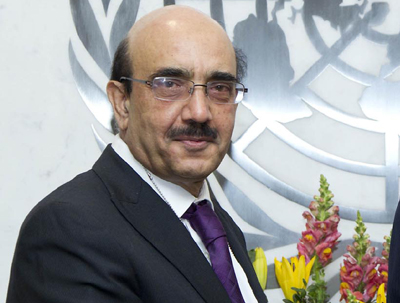
 UNITED NATIONS: A top Pakistani diplomat told the United Nations Development Programme (UNDP) Monday that the new Pakistan government was determined to deal with the country's multi-pronged challenges of poverty, education, energy, population and urbanization.
"Addressing this vicious cycle is one of the primary objectives of the new Government in Pakistan," Pakistan's UN Ambassador Masood Khan said in a speech to the UNDP annual Executive Board meeting in New York.
The Pakistani envoy spoke after UNDP Administrator Helen Clark outlined before the 36-member board her plans to sharpen the organization's focus, scale up partnerships, and streamline operations in fighting poverty and promoting good governance worldwide.
"We have not faced easy times in Pakistan," Ambassador Masood Khan said while elaborating the challenges and problems facing the country. Pakistan, he said, will address its core development challenges, despite significant stresses resulting from the heavy cost of the fight against terrorism. "Our people have been a barrier against the forces of darkness and terror," the Pakistani envoy said, adding: "They have exhibited resilience."
"The people of Pakistan fearlessly voted for democracy last month defying intimidation and violence," he said referring to the May 11 national polls in which Prime Minister Nawaz Sharif's PML-N party swept the polls.
"They have voted for national cohesion, effective governance, stable economic development, redress of energy deficits, social and gender equality, accountability, and justice. This verdict is in sync with the purposes and principles of the United Nations Charter."
Masood Khan also drew attention to the recurring large-scale floods, earthquakes, droughts, and landslides are all external shocks as imposing tremendous cost on agriculture, industry, infrastructure and livelihoods.
Similarly, he said, overcoming a shortage of more than 6000 Mega-Watt of energy and in fact taking it to its maximum potential require sustained national commitment as well as strong international cooperation. Pakistan is the sixth most populous country in the world and close to 37% of its population lives in urban areas making Pakistan the second most urbanized country in South Asia, he pointed out.
To meet the development challenge caused by rapid urbanization, Pakistan would focus on competitiveness by expansion of urban city markets, promotion of cluster development, improved urban governance, skill development and autonomous local government without undermining the rural development.
To implement Phase II of the UN One Programme envisaging effective coordination in the areas of development, humanitarian assistance and the environment, the Pakistani envoy said the total financial resources required during the five-year period 2013-17 were estimated at US $1.9 billion that average out at around $380 million per year.
"UNDP has been a valuable partner in our endeavours, He said. "We are confident that we will strengthen this partnership even more." As regards UNDP's Vision as one, which corresponds to the ideals of the international community: eliminating poverty and, more importantly, eliminating extreme poverty by 2030, he said Pakistan would lay emphasis on enhancing the resource endowment of the poor people as part of the capacity building to create livelihoods.
"In our view, enhancing the resource endowment through micro-finance, clear title to land and valuing natural capital available to them would be crucial aspects of overcoming poverty. We look forward to continuing our engagement in a constructive spirit to contribute to the strategic vision."
Stressing the organization's role, Masood Khan said, "The UNDP must emerge as dynamic institution that can align its goals and objectives closely with the collective voice of the international community and help facilitate transformation at the national level.






















Comments
Comments are closed for this article.