

Hundreds arrested in Chile on second day of strike

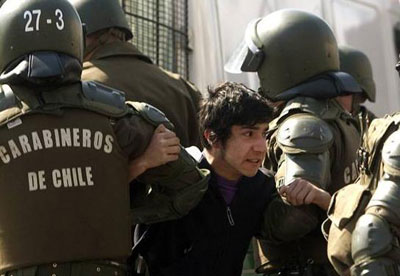 SANTIAGO: A 48-hour national strike in Chile has led to two nights of violence and hundreds of arrests, with clashes breaking out on Thursday during student protests demanding education reforms.
Around 175,000 people in dozens of towns took part in the protests, including 50,000 in downtown Santiago who demonstrated in a festive atmosphere despite occasional clashes between police and youth.
But elsewhere in the country the protests turned more violent, with 27 people wounded overall and 210 arrested, according to authorities.
The violence did not, however, rise to the level of Wednesday's clashes -- the worst unrest of rightwing President Sebastian Pinera's 17-month-old presidency -- when 36 people were wounded and 348 arrested.
Authorities said 42 police officers were also wounded in Wednesday's fighting, with six of them suffering gunshot wounds.
Throughout Wednesday night, demonstrators known as "encapuchados" (hooded people) fought police with stones, sticks and sometimes firearms, and erected barricades of burning tires or wood across Santiago.
According to Chilectra power company, some 50,000 residents in Santiago suffered power cuts due to demonstrations or vandalism.
Government spokesman Andres Chadwick said the demonstrations on Thursday were occurring "without major problems" but denounced the overnight violence, which he said would come to define the strike.
"This is not a positive outcome," Deputy Interior Minister Rodrigo Ubilla said early Thursday. "This is violence, stemming from people who are trying to disrupt public order."
The strike was called by Chile's leading labor union, the 780,000-strong Confederacion General de Trabajadores (CGT), in support of university student demands for far-reaching education reforms.
For three months now Chile has seen mass protests calling for the elimination of a voucher system that supports private universities and demanding free, higher quality education at public universities.
CGT says 600,000 people participated in the massive strike and 80 percent of public workers took part. The Ministry of Labor said that just 9 percent of public workers went on strike.
The protests on Wednesday and Thursday also included demands for improved working conditions for hospital and emergency workers.
Pinera, Chile's first rightwing leader since the 1973-1990 military dictatorship of Augusto Pinochet -- which erected the current education system -- meanwhile accused strike organizers of "trying to hurt Chile."
"A protest march is one thing, it is quite another thing to attempt to paralyze the country," he said. "When the country is paralyzed, nobody wins, everybody loses."
Copyright AFP (Agence France-Presse), 2011





















Comments
Comments are closed for this article.