


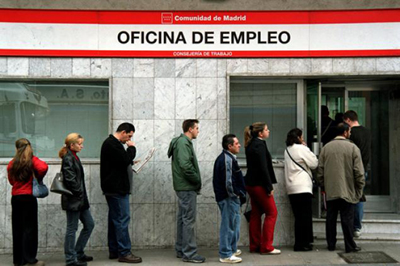
 MADRID: Spain announced Friday its jobless total soared above five million people at the end of 2011, pushing the unemployment rate to 22.85 percent, the highest in the industrialised world.
The news made grim reading for Spaniards, who face the prospect of recession in 2012 with jobless numbers likely rising even further as national and regional governments axe spending.
The number of unemployed burst through the five-million mark, surging 295,300 to 5.27 million in the last quarter of 2011, the National Statistics Institute report showed.
As a result, the jobless rate hit the highest level since the first quarter of 1995, rising to 22.85 percent at the end of the year from 21.52 percent the previous quarter.
Young people were hit especially hard, with more than half of 16-24 year olds -- 51.4 percent -- out of work on December 31 compared with 45.8 percent on September 30.
At a jobs centre in the outskirts of Madrid, people queuing in the morning cold were resigned.
"The local authorities are cutting now more than ever. Before the job agency would call me all the time. Now you can go six months of the year without them calling," said Isabel Ruiz, a 40-year-old social worker and mother of a 15-month-old boy.
Daniel Gazdoiu, 44, a Romanian, lost his job as a van driver for a building firm just two weeks earlier.
"I have just become unemployed. Things are going badly. I worked for seven years as a driver in a building firm but now there is no work. We will see if we can find work here or in another country."
It makes a stark contrast from the heady days of Spain's property boom, when the unemployment rate fell to just 7.95 percent in 2007.
The 2008 property bubble collapse and global financial crisis destroyed millions of jobs, left banks with huge bad loans, and Spain's national and regional governments with big debts.
The country's new right-leaning Popular Party government is now struggling to slash a bloated public deficit and avoid being dragged back to the centre of a crisis of confidence in eurozone sovereign debt.
Prime Minister Mariano Rajoy plans 8.9 billion euros ($11.7 billion) in new budget cuts, tax increases to rake in 6.3 billion euros, and an anti-tax fraud campaign to recoup about 8.2 billion euros.
But that cost-cutting opens the prospect of even more job losses in hard economic times.
The International Monetary Fund predicts the Spanish economy will shrink by 1.7 percent in 2012 and another 0.3 percent in 2013.
Higher jobless numbers make it extremely difficult to curb the deficit because the state must pay more in unemployment benefits while receiving less income from taxes.
Doubts are now rising over whether Rajoy can fulfill a promise to cut the deficit to 4.4 percent of gross domestic product in 2012 after the deficit blew out to an estimated 8.0 percent of GDP last year.
"Spain will respect the deficit target. Today that is 4.4 percent and Spain will respect that target," Rajoy told a news conference this week.
On Sunday, Spanish budget minister Cristobal Montoro had called for the deficit target to be relaxed because the 2012 growth forecasts on which it was
based no longer look attainable.
But Spain is now reaching a tipping point may it may have to ease up on cost-cutting to save jobs, said Raj Badiani, London-based economist at IHS Global Insight.
"There appears to be a growing consensus that international investors could decide to cut Spain some slack with regards to its multi-year budget deficit reduction plan, noting that Spain's devastated labour market is a greater risk than missing well established budget deficit targets," he said in a report.























Comments
Comments are closed for this article.