


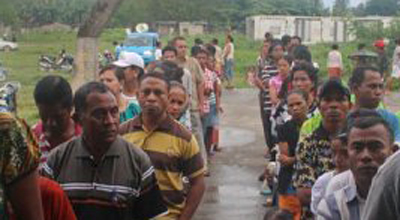
 DILI: East Timor's voters went to the polls on Saturday in parliamentary elections seen as a key test for the young and fragile democracy and likely to determine if UN peacekeepers can leave by the end of the year.
Polls opened at 7:00 am (2200 GMT Friday) and voting continued until 3:00 pm for some 645,000 registered voters, who trickled in a steady stream at polling stations across the capital Dili.
There have been concerns that violence could reignite in the energy-rich but underdeveloped state if, as predicted, none of the 21 parties wins a parliamentary majority and a fragile coalition takes power.
Presidential polls that were held over two rounds in March and April, however, passed off peacefully.
The United Nations sees Saturday's elections as the last big test that will decide whether its remaining 1,300 peacekeepers and other security staff can withdraw as planned within six months.
Following the end of Portuguese rule in 1975, East Timor was occupied by Indonesia for 24 years. Some 183,000 people died from fighting, disease and starvation before the half-island state voted for independence in 1999.
The country has offshore fields of oil and natural gas and its Petroleum Fund has swelled to $10 billion, but corruption is endemic.
Half of East Timor's 1.1 million people are officially classified as living in poverty, posing the main challenge for the future government.
"I want the government to look after infrastructure and improve healthcare for the people," said Martinho Afonso, a 55-year-old farmer, as he cast his ballot in the Dili suburb of Farol.
"Things need to improve for the poor people in rural areas, where people have no home, no electricity, no water," he said.
The left-wing Fretilin party, which is synonymous with the pro-independence struggle, has campaigned on a populist platform of spending oil revenues to lift income and education levels.
The centre-left National Congress for Timorese Reconstruction (CNRT) is promoting longer-term investment on major infrastructure projects such as roads, electricity and water.
CNRT leader Xanana Gusmao, a charismatic figure and a resistance hero during the struggle for independence, is fighting to stay on as prime minister.
Gusmao kissed voters and joked with journalists and observers after casting his ballot with his wife at a small polling station around the corner from his residence in Dili's beachfront suburb of Bidau Lecidere.
The vote will decide whether East Timor, which celebrated a decade of formal independence in May, is ready to take on its own security.
A 450-strong International Stabilisation Force (ISF) made up of troops from New Zealand and Australia is also awaiting the outcome of the poll before finalising a pullout.
The United Nations Integrated Mission in East Timor (UNMIT) -- with a total current military, police and civilian force of about 3,000 -- was deployed in 2006, after a political crisis in which dozens were killed and tens of thousands displaced, with a mandate to restore security.
The only major violence since then was a failed assassination attempt in 2008 on then president Jose Ramos-Horta, the Nobel peace laureate who lost to Taur Matan Ruak in the recent presidential election.
Ramos-Horta, who still commands popular respect, has thrown his weight behind the 66-year-old Gusmao and a unity government.
However, Fretilin, which received the largest number of votes in 2007 but failed to form a coalition, has dismissed any talk of working with the CNRT on forming a post-election government.
"Fretilin should win, and I believe that even if we don't Fretilin will still have a political role in the future," said party president Francisco Guterres, popularly known as "Lu Olo," after casting his ballot.
Lu Olo, who lost to Ruak in a second round of voting in the April presidential election, said "health, education infrastructure and other things which are important for the people's lives" are top priorities and "it is very important for all political parties to respond to these needs".





















Comments
Comments are closed for this article.